
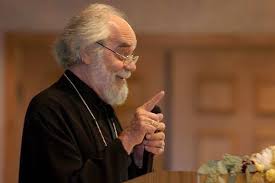
Those familiar with liturgical worship will be familiar with the pre-anaphoral dialogue— the dialogue between celebrant and people that takes place just before the celebrant prays the anaphora, the long prayer over the bread and wine which consecrates them to be the Body and Blood of the Lord soon to be received in Holy Communion. It is an important dialogue, indeed, even a crucial one, for it constitutes the celebrant’s blessing from the royal priesthood (i.e. the assembled laity) to offer the Eucharist in their name and as their mouthpiece. That is why he faces them throughout—or should face them, as Fr. Sergei Glagolev (inset above) taught us. Besides, who turns their back to someone in the middle of talking to them?
In its Byzantine form (it is universal both in the west and the east) the preface says:
Celebrant: The grace of our Lord Jesus Christ, the love of God the Father, and the communion of the Holy Spirit be with all of you!
People: And with your spirit!
Celebrant: Let us lift up our hearts.
People: We lift them up unto the Lord.
Celebrant: Let us give thanks unto the Lord.
People: It is meet and right to worship the Father and the Son and the Holy Spirit, the Trinity one in essence and undivided.
In this dialogue (or Preface, to give its technical name) he is not simply greeting them in welcome. That had already been done at the beginning of the Liturgy when he ascended to his chair in the high place located east of the altar table saying to them, “Peace be unto all!” (The nature of this opening greeting is now obscured by placing a litany and three antiphons before it.) He has no need to welcome them again so far into the service. Rather, the greeting with the preface unites celebrant and people into one. The priest is not offering the Liturgy for the people like concert musicians play music for listening concert-goers. The priest is offering the Eucharist in their name. Or to state it better, it is the entire people of God, the Body of Christ with the celebrant at their head, that offers the Eucharist. That is why the priest faces the assembly at this moment of unity as they have their dialogue.
Here I would like to focus upon one part of the dialogue. A similar kind of dialogue is found in the document known as the Apostolic Tradition ascribed to St. Hippolytus and representing (some say) the liturgical practice of the Roman church around 215 A.D. In the section concerning “the bringing-in of lamps at the communal agape supper” we read the following:
“When the bishop is present and evening has come, a deacon brings in a lamp and standing in the midst of all the faithful who are present, the bishop shall give thanks. First he shall say this greeting:
‘The Lord be with you!’ and the people shall say,
‘And with your spirit’.
‘Let us give thanks to the Lord’, and they shall say,
‘It is meet and right: greatness and exaltation with glory are His due’.
And he does not say, ‘Lift up your hearts’ because that is said only at the [Eucharistic] offering.”
Note the emphasis on what is omitted: the tradition insists that the bishop (then the main celebrant at every Sunday Liturgy) does not tell the people to lift up their hearts because that is done only at the Eucharist.
What is going on? Why the insistence on omitting this bidding from the agape feast when the evening lamps are brought in? What is specifically Eucharistic about this bidding? (We note in passing that the bringing-in of a lamp was a feature in every evening service and indeed in every private home, whether pagan, Jewish, or Christian. The lamp provided illumination. Without it, everyone would be sitting in the dark.)
The answer to the question provides the answer to the question in our title, “Where does the Eucharist take place?” That is, every Eucharist takes place in heaven. That is why the celebrant bids the royal priesthood to lift up their hearts to heaven where the Lord is, the Lord who is Himself the offering and true high priest who offers. The bidding is not a liturgical invitation to cheer up but an invitation to ascend.
We find this wonderfully expressed in Fr. Alexander Schmemann’s For the Life of the World. In the chapter on the Eucharist, Schmemann writes, “It is precisely this preface— this act, these words, this movement of thanksgiving— that really ‘makes possible’ all that follows. For without this beginning the rest could not take place. The Eucharist of Christ and Christ the Eucharist is the ‘breakthrough’ that brings us to the table in the Kingdom, raises us to heaven, and makes us partakers of the divine food… It is indeed the preface of the world to come, the door into the Kingdom”.
Fr. Alexander states this even more concisely in his volume The Eucharist: “The next exclamation of the celebrant, ‘Let us lift up our hearts’ we find in no other service— it belongs entirely and exclusively to the divine liturgy. For this exclamation is not simply a call to a certain lofty disposition… It is an affirmation that the eucharist is accomplished not on earth but in heaven”.
I suppose I should’ve doped this out long ago because it is found in the Bible. St. Paul told the Ephesians that they were seated (literally co-seated; Greek συγκαθίζω/ sugkathizo) with Christ in the heavenlies (Ephesians 2:6). And in Hebrews 12:22f we are told that as Christians we come not to an earthly place like Mount Sinai but to the heavenly Mount Zion, the city of the living God, the heavenly Jerusalem, a place of myriads of angels. The reference is to Christians coming to the Eucharist. How could I have missed it?
But miss it I did, even when it was in the Eucharistic text. When I was an Anglican, the Book of Common Prayer from which I worshipped retained that idea. After the eucharistic preface, the celebrant prays, “Therefore with angels and archangels and with all the company of heaven, we laud and magnify thy glorious Name…”. Protestant guy that I was, I thought it meant that we were praising God on earth even as the angelic choirs praised Him in heaven. But that is not what the text actually says. Being a revision of old western catholic texts, it says that we praise God not just at the same time as the angels, but with the angels. (I am not sure if Cranmer, the first creator of the Prayer Book “got it” or not, but there you have it.)
A seminary textbook said the same thing. In his 1958 work An Introduction to the Theology of the New Testament Alan Richardson explained “Though the eucharists of the Church were celebrated in somebody’s drawing-room they were nevertheless a participation in the worship which is for ever offered at the golden altar that stands before the throne of God in heaven, where the angels with their golden censers add their incense to the prayers of all the saints (Rev. 8.3).” I read that sentence back in 1977 but still somehow managed to miss the point.
For what is the point? The point is the eschatological nature of the Church and of Christian identity. St. Peter wrote to his Gentile converts that they should regard themselves as strangers and sojourners on the earth and that they belonged to the Eschaton. Or, to state it differently, the Church is the presence of the Eschaton on earth, the presence of the future. This eschatological nature of the Church which informs our identity also informs our behaviour. We behave differently than others, as those who belong to the age to come “where righteousness dwells” (2 Peter 3:13).
It also, by the way, explains other things in the Church. It explains why we adorn our church walls with images of the Theotokos and the saints in heaven. How could we not, when we ascend to heaven each week and celebrate the Eucharist there? It also explains the joyful element in Christian funeral rites where we exult in the mercy of God which gives rest to the Christian dead and turns our funeral dirge into the cry “alleluia”.
Perhaps the last word may go to Fr. Sergei Glagolev, of blessed memory, my liturgics teacher at St. Tikhon’s Seminary. He told us not only that the celebrant should face the people for the entire preface dialogue. He also told us that every word of the Liturgy was alive with meaning, that they should be heard by all the faithful and should be hearkened to. That included the little bidding “Let us lift up our hearts”. Fr. Sergei knew what he was about.
About Fr. Lawrence Farley
Fr. Lawrence currently attends St. John of Shanghai Orthodox Church in North Vancouver, BC. He is also author of the Orthodox Bible Companion Series along with a number of other publications.