

The feminist push to reject the parts of our Tradition that are no longer fashionable and institute practices forbidden by that Tradition (such as the ordination of women priests and bishops) employs many arguments. One of these arguments concerns the Eschaton—i.e. the age to come. It is pointed out that some Fathers (predominately eastern fathers, some of whom, I suggest, had too warm an appreciation of Origen) believed that God first created genderless human beings and only later created gender differentiation. The provision of gender, it is further suggested, was added because God foresaw that the Fall would result in death and instituted sexual reproduction as a remedy so the race wouldn’t die out. Sex and gender became therefore a kind of “Plan B”.
This was not the understanding of such western Fathers as St. Augustine (see his City of God, book 14, chapter 23). Some Orthodox easily and cheerfully sideline the prolific and blessed bishop of Hippo along with his ilk despite his importance to the Christian world of his day and insist, with some eastern Fathers, that sex was a kind of provisional stop-gap. But a scholarly exegesis of Genesis will not so easily excise sex from God’s original design for humanity. In fact, the divine command to multiply assumes sexuality as part of the original package and there is nothing in rest of the Hebrew Scriptures to suggest that sex was invented with any divine reluctance. Though it is now fallen, sex like everything else (including eating), was one of God’s gifts. That is the abiding significance of the inclusion of the Song of Solomon in the Old Testament canon despite the attempts of Origen and his friends to allegorize the whole thing and effectively sweep it out the back door.
Feminist argument often pairs an understanding of the ontological irrelevance of gender in the creation stories with gender’s supposed absence in the age to come. Some eastern Fathers opined that gender would cease to exist in the Eschaton as we all returned to our original genderless state.
It is true that Christ taught that “in the resurrection they neither marry nor are given in marriage but are like angels in heaven” (Matthew 22:30). Christ said that as part of His answer to those who asked Him which one of the seven sequential husbands one woman had would get the woman in the age to come. The question presupposed the same sort of existence we experience now, which included weddings (i.e. being “given in marriage”, doubtless under a Jewish chuppah), childbirth, child-rearing, and setting up a nice little house together. The Lord said that those earthly conditions would no longer apply in the age to come. That is, weddings, sex, having kids, and raising a family would no longer form a part of our existence in the Eschaton any more than it formed a part of the angels’ existence (Genesis 6:2 notwithstanding). It is quite a leap to go from “no sex, please” to “gender does not exist”. The latter simply does not follow from the former. Even in this age, as single Christians can attest, celibacy does not negate gender. Celibate men and women are still men and women.
We see this persistence of gender after the resurrection in the case of our Lord. After His resurrection, He was still a male and recognizable as such by the apostles. Given that our Lord’s resurrected body is the model for our own, His risen form suggests gender does indeed persist in the age to come. Not sexual activity, but gender. Sorry: Origen was wrong.
Nonetheless, some make the argument that because there will be no gender or sexual differentiation in the age to come, gender differences should not matter now. Gender is this age is downgraded and dismissed as “fallen and post-lapsarian” and therefore of no significance for life in the church including (wait for it) liturgical participation. Feminists talk about life in the Church being “shaped by the fallen world”. In other words, because (let us grant for now) gender differentiation will have no existence in the age to come we may dismiss gender distinctions in this age.
The whole thing is an immense non sequitur. It is a bit like saying “the necessity of eating to survive will not exist in the age to come and so we may dismiss the role and rules governing the Eucharist in this age”. As a matter of fact, everything in this world is fallen, including sex, eating, emotions, thinking, and hierarchy. And everything that God gave us will be healed in the age to come but that future healing is largely irrelevant to how we live now. When someone points out that gender will not exist in the Eschaton and suggests that women may therefore be ordained priests now, it is enough to point out that we are not presently in the Eschaton and so until we are, gender differentiation and the apostolic rules built on it remain in place.
It might help to take another less controversial example, not from liturgical participation but from the home. Mothers and fathers have different roles in the home and different places in hierarchy (thus St. Paul’s instructions to husband and wives in Ephesians 5). All children know this which is why when a young child skins his knee he usually runs straight past the dad to find the mom. He knows that mom will kiss the ow-y and make a big fuss whereas dad will probably just say “You’re fine” and tell him to walk it off. Moms and dads are different and the child knows it. It would be nonsensical to try to abolish this difference by denigrating it and saying that the difference between mom and dad is a part of the “fallen post-lapsarian human nature” and is “shaped by this fallen world”.
That is not doing theology; that is blowing smoke; it is trying to muddy the water by introducing things which have nothing to do with the question at hand, whether the question is the differing roles of fathers and mothers in the home or the question of women’s ordination. Until the Lord returns, everything in this world and therefore in the Church is “shaped by this fallen world”—or, more accurately, has to function in this fallen world. The fact that things like gender roles in the family or liturgical participation in the Church are exercised in this age does not for a moment mean that the fallenness and sin that characterize the age also characterize them. On the contrary, such things as gender roles are characterized by the fact that they were divine gifts given at creation, prior to the Fall. The fact that they will be transcended and left behind in the Eschaton does not now in this age alter their character as gifts—and gifts that define us and our behaviour.
The gift of gender differentiation (with its relevance to liturgical participation) therefore persist in this age and with them, the rules governing such differentiation. No sane person would argue, for example, that because sexual differentiation will not exist in the Eschaton that the current rules forbidding same sex unions can now be dispensed with. One may argue for the legitimacy of such unions if one is so inclined but one should leave the Eschaton out of it. We are not there yet.
I believe that, at the end of the day, the feminist drive to ordain women priests is rooted in the desire to conform to secular ideology. Being Orthodox, they feel the need to somehow justify this change of theology and praxis by an appeal to the Fathers, even if a certain patristic selectivity is required to get the desired result. This is not honest. Quote Maximus the Confessor all you like; if he were alive today he would still refuse to countenance women priests. The debate about women’s ordination is not well served by dragging in such irrelevancies as a supposedly genderless Eschaton.
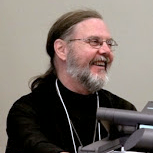
About Fr. Lawrence Farley
Fr. Lawrence currently attends St. John of Shanghai Orthodox Church in North Vancouver, BC. He is also author of the Orthodox Bible Companion Series along with a number of other publications.