
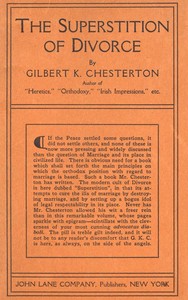
In 1918 G. K. Chesterton wrote a series of five articles for the New Witness condemning the (then current) move in England to enact more liberal divorce laws. The articles were collected and published in 1920 under the title The Superstition of Divorce (image inset), a first-edition of which was given to me as a kind gift by a very dear friend. In the book Chesterton argues at length against the legalization of divorce. In his “Conclusion” added in 1920 he says that the book was really a mere pamphlet and that pamphlets of necessity wrote about passing things and that he hoped the fad of legalized divorce would be one of them. Of course, it wasn’t.
I am, with many others, a great admirer of Chesterton (who converted from Anglicanism to Roman Catholicism in 1922— at that time in England, a rather daring thing to do). However, no one bats a thousand, including GKC (or even, though it grieves me to say it, CSL) and this book constituted an embarrassing misstep. So why talk about it now over a hundred years after it was published?
Because Chesterton asked a number of basic questions about the nature of marriage, questions around which debate still swirls. Even today I get questions from inquirers into Orthodoxy asking, “Why does the Orthodox Church allow divorce— i.e. remarriage after divorce? The Catholics don’t and Jesus seemed to forbid it.” Chesterton’s old book provides me with a peg on which to examine this and other questions. Let’s look at the book.
After the usual entertaining Chestertonian verbal fencing, Chesterton begins in chapter one by defining marriage as a vow. That was a reasonable beginning, given that the Anglican marriage rite contained vows in which the bridal couple vowed to stay together “until death do us part”. But that is not to begin at the beginning because marriage as an institution was something very different in the world before the coming Christianity.
In pagan culture and Jewish culture, marriage was not a vow which could not be broken but a contract which could. That is why divorce was taken for granted as a possibility in pagan Rome and provided for in the Torah (Deuteronomy 24). Jewish interpretation of that Torah passage varied somewhat in our Lord’s day. Some interpreters (e.g. Shammai) ruled that divorce was permitted only in cases of sexual impropriety while other interpreters (e.g. Hillel) ruled that it was permitted for any reason whatsoever. (Unsurprisingly Hillel’s opinion was the more popular.) But all Jews reading the Torah agreed that marriage was a contract that could be ended by divorce, freeing the divorced for re-marriage. Marriage was not regarded as taking an oath to stay together no matter what.
When Jesus was asked for His opinion on the question of how to interpret Deuteronomy 24 (i.e. could a man divorce his wife for any reason, as Hillel alleged) He referred them back to the origin of marriage in Genesis (i.e. “What did Moses command you?”). His hearers referred to the Deuteronomy passage and replied that Moses allowed it. But Christ’s question was not “What did Moses allow?” but “What did Moses command?” and He pointed out that in Genesis we read that “for this reason a man leaves his father and mother and cleaves to his wife and the two become one flesh”.
In other words, in marriage (i.e. in sexual intercourse) two become one, a new creation out of the old, a new single organism. Since this was the work of God, this meant that to divorce was to thereby undo God’s work, splitting the new single organism in two. The ideal, Christ said, was never to do this and His disciples were commanded to follow the ideal. To divorce one’s wife and to marry another was a form of adultery.
Here we need a reminder about how to hear Christ’s words. Christ was not legislating, providing legal material for the coming Byzantine empire. He was deconstructing innate presuppositions and those who held them, using His customary hyperbole to shock and jolt His hearers into receptivity.
Thus, for example, His teaching on how to deal with ingrained sin: if your hand causes you to sin through temptation to theft, chop it off and throw it away; if your eye causes you to sin through temptation to greed or lust, gouge it out and throw it away (Mark 9:47). His counsel was urgent but not literal. Christ was here counseling radical opposition to one’s own sin, not physical amputation or ocular mutilation.
It is sometimes said that the Gospels provide the questions and the Epistles provide the answers, that Christ’s ministry offers vision while the Church provides the programme. That is, we learn how to actually apply Christ’s words by discovering how the apostolic church actually applied them. How did the early church (and the patristic church afterwards) apply Christ’s words? How did they turn vision into law and pastoral guidance?
We see an example of this in Paul’s words in 1 Corinthians 7. And once again we remind ourselves that Paul was not writing as a lawyer giving decisions for every single situation. As a true pastor he dealt with individual situations individually. Here he was writing about general principles, not trying to legislate for every situation. And Paul says, following Christ’s explicit teaching (“I give charge, not I but the Lord”) that Christians should not divorce each other (verse 10).
But what about mixed marriages, cases where a Christian was married to a non-Christian? Here Paul admits that Christ did not deal with that situation (“I say, not the Lord”) but he says they should stay together if they can. But, he adds, if the non-Christian divorces the Christian, the Christian may depart (the freedom to re-marry is assumed in that culture) for “in such a case the brother or sister is not bound” (verse 15).
From Paul’s counsel we see that the early church did not interpret Christ’s words literally or as covering every conceivable situation. Christ was speaking of general principles among His devout disciples. The reality to which such principles had to be applied was more complex and required adjustment in certain cases.
That was how the patristic church interpreted Christ’s teaching. In the words of the late Fr. John Meyendorff in his Marriage: an Orthodox Perspective, “the Church never considered the Gospel as a system of legal prescriptions which human society could adopt overnight. The Gospel was to be accepted as a commitment, as a pledge of the Kingdom to come; it presupposed constant personal struggle against sin and evil, but it never could be reduced to a system of legal ‘obligations’ or ‘duties’”.
That is why in the Byzantine empire re-marriage after divorce was reluctantly allowed after a period of penitence. To quote from St. Epiphanius (whom no one ever accused of being too lax or easy-going) “He who cannot keep continence after the death of his first wife or who has separated from his wife for a valid motive such as fornication, adultery or another misdeed, if he takes another wife the divine Word does not condemn him nor exclude him from the Church but tolerates it rather on account of his weakness” (Against Heresies, chapter 69).
We see then that Mr. Chesterton’s view of the impossibility of divorce because it was a binding vow was not that of the patristic Church.
The liberalization of the divorce laws which Chesterton was protesting was not, of course, based on patristic precedent but on professed compassion. In particular, the liberalizers said that it was lacking in compassion to insist that a couple be forced to stay together in cases of drunkenness or cruelty— e.g. in cases where the husband returned home drunk every night and beat up his wife. In such cases, they opined, divorce should be allowed.
Here was where Chesterton became, to my mind, a bit embarrassing. He wrote that such things were “very decidedly matters of opinion” and that “the misfortune of the woman who has married a drunkard may have to be balanced against the misfortune of the man who has married a teetotaler. For the very definition of drunkenness may depend on the dogma of teetotalism”. As anyone familiar with the challenges of living with an alcoholic can attest, this is nonsense. It will not do to dismiss cases of constant drunkenness (with all the abuses that usually come with it) as simply the over-sensitive and dogmatic scruples of a teetotaler.
Regarding the liberal plea that divorce should be allowed in cases of “cruelty” (i.e. domestic violence) Chesterton was even more strange. He wrote that “nine times out of ten the judgment on a navvy [i.e. a labourer working on roads or railways] for hitting a woman is about as just as a judgment on him for not taking off his hat to a lady… It leaves out a thousand things; the provocation, the atmosphere, the harassing restrictions of space, the nagging”.
Mr. and Mrs. Chesterton did not have any children. My guess is that if they did and if his daughter regularly came home battered and bruised by domestic violence, he would not have written as he did.
Here we may also look at what are called “grounds for annulment”. An annulment is not a divorce but a legal decision that a couple were never really married in the first place despite the fact that they went through the legal form of marriage. Such grounds included things such as “shot-gun marriages” wherein a man is forced by the girl’s father at effective gunpoint to marry the girl, usually because of prior sexual contact.
Marriage by definition must be freely chosen and the absence of freedom invalidates the marriage. For the same reason a marriage could be annulled if one did not remember getting married— e.g. if a couple got very drunk in Las Vegas, got married in a wedding chapel, and woke up in bed together the next morning with no recall of what happened the night before.
There are other legal grounds for annulment, such as the wilful withholding of information from the other partner which would have changed their mind about getting married if they had known. Thus, if one partner withholds the fact that they have a sexual disease or cannot conceive and this fact would have led the other partner to not marry if they had known, this is grounds for annulment.
This being so, one may ask: what if one partner knew in advance that the other had a problem with alcoholism or violence? Or if they knew that the partner would develop a problem with alcohol or violence? If withholding knowledge of sexual disease was grounds for annulment should not withholding knowledge of a proclivity for violence be grounds for divorce?
The fact is that life is complicated and cannot be reduced to a single rule which covers all cases. Let me be clear: I agree that we should indeed loudly lament the ease with which divorce is obtained today (i.e. for any reason at all) and its widespread prevalence with the cost to the children of such couples. Christians who read the Lord’s words or church history will always regard divorce as a tragedy and will counsel heroic patience in the face of daily domestic challenges. But, Chesterton’s legalistic ideology notwithstanding, sometimes marriages die. To quote Meyendorff again, sometimes people lose “the constant personal struggle against sin and evil”.
Perhaps in discerning such cases one might ask this question: will husband and wife staying together cause more harm than good to the children and to each other? Life cannot be reduced to mathematical formulas and there is no such thing as a moral slide rule to discover the answer. The patristic church of the Byzantine east allowed re-marriage after divorce up to three times in its compassion and concern for the weakness of humanity as couples struggled to repent and learn. And whether it be 1920 or 2026, compassion is always in season.

About Fr. Lawrence Farley
Fr. Lawrence currently attends St. John of Shanghai Orthodox Church in North Vancouver, BC. He is also author of the Orthodox Bible Companion Series along with a number of other publications.