
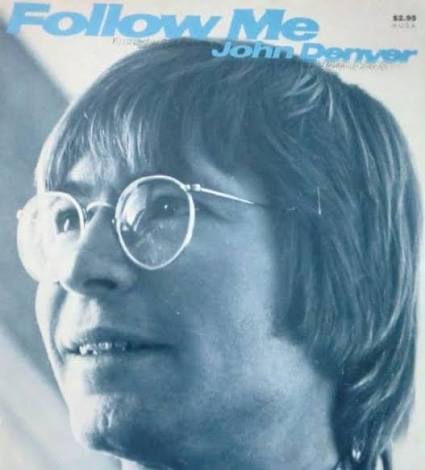
Dinosaur that I am, I freely admit to loving the music of John Denver. “Take Me Home, Country Roads”, “Annie’s Song”, “Rocky Mountain High”—my suburban soul loves them all. It was with that kind of devotion that I first heard Denver’s song “Follow Me” written in the 1970s. It is a love song, offering a kind of marriage proposal to his true love and its refrain runs like this: “Follow me where I go, what I do, and who I know. Make it part of you to be a part of me. Follow me up and down, all the way and all around. Take my hand and say you’ll follow me.”
I loved it and listened with rapt attentiveness until the last four words of the song when there came a change in the refrain that jarred me and left me saying, “Wait, what?” Denver concluded his lyrical love proposal by saying, “Follow me up and down, all the way and all around. Take my hand and I will follow you.”
“Follow you?” Who was following who? The lyrics left me with an image of two people staring at one another in perplexity, each one saying to the other, “You’re following me? I was following you! Which one of us is leading?”
Presumably Denver made the jarring change out of respect for modern feminism which famously abhors the notion of male headship and he wanted to avoid any such male chauvinist sentiments.
I mention the song because (prior to the last four jarring words) it seemed to sum up what St. Paul meant by the concept of male headship in marriage.
It is true that even today (or maybe even especially today) the notion of male headship is problematic to some. It summons up images of rude husbandly domination of a cowering wife who is chained to the home, doomed to be perpetually pregnant, barefoot, and in the kitchen, subservient to a husband who is a kind of Archie Bunker on steroids, a man who orders his woman to get him a sandwich—all of which, needless to say, is not what St. Paul was envisioning or counselling.
But it is often this distorted understanding that obtains whenever feminists talk about that dreaded thing “the patriarchy”. Such was the case in Dr. Phil Dorroll’s article in Public Orthodoxy entitled, “History or Virtue: A Response to Drs. David and Mary Ford”. (The Fords’ article to which Dr. Dorroll was replying can be found here.) Like all feminists, Dr. Dorrell seems to view men and women through the lens of power and power struggle. He acknowledges that male headship has history backing it up, but he denies that it is virtuous. I disagree. I submit (no pun intended) that it has the backing of both history and virtue. The Fords were correct: patriarchy and male headship in marriage are not about wielding power but about offering leadership. Note: not demanding leadership but offering it.
Admittedly, it can seem like it is about power at first glance. In Ephesians 5:22f St. Paul issues instructions to Christian wives, part of which includes the counsel to “be subject” to their husbands even as the Church is subject to Christ. The word rendered “be subject” is the verb ὑποτάσσω/ upotasso, the same word used in Luke 10:17 to describe how the demons were subject to the apostles during exorcisms.
We should note however that just prior to this instruction for wives to be subject to their husbands St. Paul instructs everyone in the Christian community to “be subject to one another in the fear of Christ”. The apostle was envisioning a community in which everyone respected everyone else and treated them with the dignity and esteem they deserved according to individual circumstance and role. Though there was indeed a hierarchy in the church and in the family, respect and consideration were nonetheless to be given to all. And this hierarchy, precisely because it is a hierarchy in Christ, will be fundamentally different from the hierarchies of the world. Authority in the world is always about power and dominance. Authority in Christ is about service; see Mark 10:42-44.
That is why the hierarchy and authority of husbands included husbands bestowing dignity and devotion upon their wives. In particular, they were to love their wives in the same way as “Christ loved the Church and gave Himself up for her”. The implication is clear: husbands were to lay down their lives in love for their own spouses (and, may I add, get their own sandwich. And getting one for their wives while they were up).
What then does wifely submission look like? The underlying principle is clear, but its application will vary somewhat according to time, place, and culture. For example, Christians in pre-Maoist China with their own cultural inheritance (such as wives walking a few steps behind their husbands) will doubtless incarnate and apply the principles differently than Christians in North America today. But despite such diversity of application, the underlying principle of the wife following the husband’s lead still remains.
How does this all concretely work out? One wise woman I know said that basically it meant that the wife left the big life decisions to her husband (such as, she added, following him into Orthodoxy). The other decisions (such as running the home and if the wife should seek employment outside the home) were hers to decide. In other words, her husband’s leadership was based upon her trust in his wisdom and this resulted in a division of responsibilities. Such a division left her as a leader in the home— which is perhaps why in 1 Timothy 5:14 St. Paul used the verb oikodespoteo to describe the wife’s domestic role. That is, she functioned as the master of the house (the cognate noun in Matthew 24:43 can be rendered “house-master”). She had decided and was content to follow her husband in love in the major decisions because she trusted and loved him.
Such male leadership does not preclude a process of consultation with the wife. At the day’s end, the husband has the final call in such large decisions, but wisdom will require that he consult the counsel of the wife as well— indeed, a Scriptural text like Proverbs 31:11 presupposes it for it declares that the husband’s heart “trusts in her”. In this Proverbial text the wife “opens her mouth in wisdom and the teaching of kindness is on her tongue” (verse 26). We see from this that the husband’s final decisions are rooted in his hearkening to her wisdom and listening to the words of her tongue.
We find this same process of consultation and conciliarity throughout the Church’s understanding of how Christian authority works.
Take, for example, Canon 34 of the so-called “Apostolic Canons”, a collection of material relating to episcopal and clergy relations dating to about the fourth century. This canon reads as follows: “The bishops of every nation must acknowledge him who is first among them and account him as their head and do nothing of consequence without his consent… But neither let him who is the first do anything without the consent of all so that there will be unanimity and God will be gloried through the Lord in the Holy Spirit”.
Note that not only must the bishops of every city and village (for at that time each city and village had its own bishop) must acknowledge one of their number as their head and must have his consent for all major decisions, but also that the head person must do nothing without the consent of all the other bishops. Or, in the words of St. Paul written in another context, the bishops must “submit to one another in the fear of Christ” (Ephesians 5:21).
From this we see that authority and submission in the Church were a mutual two-way street. The whole process of submitting to one’s head was characterized by consultation, respect for the other’s wisdom, and love. Sadly, exceptions to this abounded in the history of the Church and still do to this day, but the authentic tradition regarding how headship should function remains nonetheless.
We also see such a spiritual concern for conciliarity and mutual submission (perhaps unexpectedly in a legal document) in the Statute of the Orthodox Church in America (the 2002 edition). In Article 10.4 regarding the Rector in his parish, we learn that the parish is not run by the Rector as a theocracy even though he is “the head of the parish”. The article stipulates that “no activities in the parish can be initiated without [the Rector’s] knowledge, approval, and blessing; neither should he do anything pertaining to the parish without the knowledge of his parishioners and parish organs elected by them, so that always and everywhere there may be unity, mutual trust, cooperation, and love”.
Here we see again that headship by definition involves a process of consultation and mutuality. Authority is not simply “from the top down” with parishioners passively, blindly, and mutely submitting to executive orders from the head. On the contrary, the input and wisdom of everyone is involved, including the parishioners and the various parish organs (such as the Parish Council).
This process of mutuality, consultation, and real involvement in decision-making applies to headship in the family as well when it comes to husbands and wives. At the end of the day, as said before, someone must lead and cast the deciding vote. Christian Tradition ascribes this demanding role to the husband. It falls to him to make the final decision— and to “wear it” ever afterward in this life and to give an account and defend his decisions before Christ on the Last Day.
In the Church, unlike in the world, authority is meant to be a means of service. That is what our Lord meant when He insisted that whoever wanted to be the first must be the slave of all and why He demonstrated exactly what that meant when He washed His disciples’ feet on their last night together (Mark 10:44, John 13:4f). Love is how authority was to be expressed because authority was love’s instrument.
It is the same regarding authority and headship in marriage. All such decision-making takes place within the context of love and mutual service. One must always remember that before the husband is the wife’s head, he is her lover— i.e. the one who loves her as Christ loved the Church and gave Himself up for her. Spouses should read the Song of Songs before reading Ephesians 5 or they run the risk of reading the apostolic counsel askew. The wife is not the husband’s subordinate or servant; she is primarily “bone of his bones and flesh of his flesh” and the joy of discovery that Adam first had when he saw Eve should suffuse their entire relationship (Genesis 2:22-23).
That is why John Denver’s song “Follow Me” is so helpful in understanding the headship of husbands. Before the singer asked the woman to follow him, he confessed his love for her. The song began with the cry of every true husband’s heart: “It’s by far the hardest thing I’ve ever done— to be so in love with you and so alone.” The song ended with the goal of all marriage, expressing the true context of what is sometimes coldly called “male headship”. This is the true voice of the husband as he leads his wife, inviting her to follow him, the voice of love: “To have you there beside me, and never be alone and all the time that you’re with me we will be at home.” Male headship presupposes devotion, and Christian authority presupposes love and service. It not only has the backing of timeless and universal historical precedent, but also the backing of the Scriptures and that of the mutual trust that exists between loving husbands and wives. The husband does not issue orders; he invites his bride to trust him and says to her in love, “follow me”.

About Fr. Lawrence Farley
Fr. Lawrence currently attends St. John of Shanghai Orthodox Church in North Vancouver, BC. He is also author of the Orthodox Bible Companion Series along with a number of other publications.