
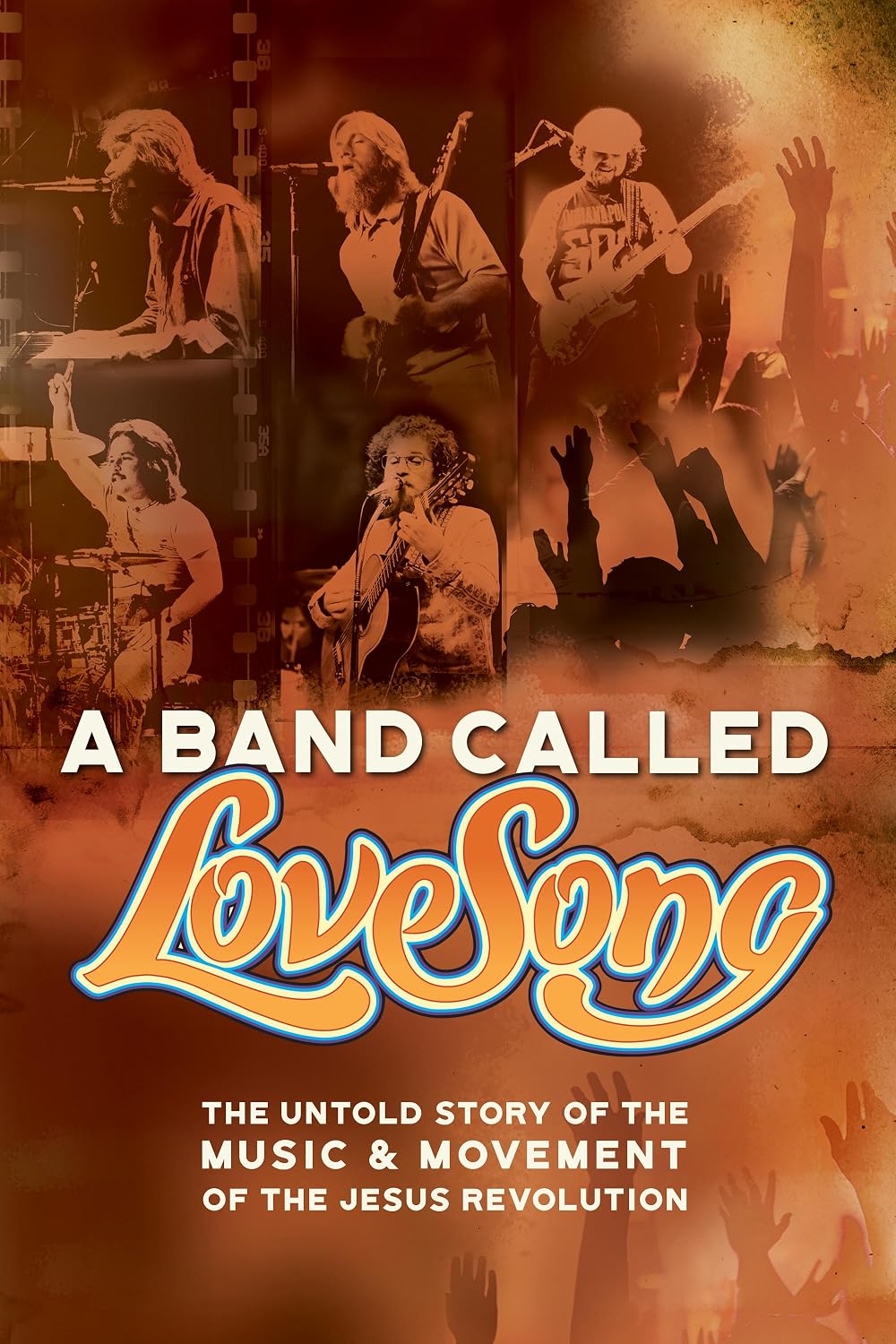
I have just finished watching a three-part documentary entitled “A band called LoveSong”, produced by the group itself and focusing upon their music and their part in the Jesus People movement in the 1970s. Pathologically nostalgic old man that I am, I enjoyed the trip down memory lane. The men in the band are now of course much older but they are still singing the old songs.
The old songs they sing were part of a genre from the Jesus Movement called “Jesus Music”. Jesus Music featured guitars and drums rather than the use of organ and piano and the guitars and drums were played by young men with long hair, beards, and blue jeans— at that time a scandalous departure from the culture of American Evangelicalism in which young men had short hair, were clean-shaven, and wore jackets and ties to church to sing hymns from the hymnal. LoveSong and Jesus Music were all a shock to the system of 1960s clean-cut Christianity.
The documentary repeatedly pointed out that groups like LoveSong were the forerunners of what is now called “Contemporary Christian Music” (CCM for short) with the guitars and drums that are now ascendent in Evangelical mega-churches. The style of worship in those churches is, shall we say, casual: one brings one’s latte into church for the service, and is treated to a concert from the house band along with a long talk from the preacher (usually, I think, with a slide presentation of sorts) stressing self-help and fulfillment. One non-appreciative observer described it as “religious entertainment with a TED talk”.
Here I would like to focus upon the Jesus Movement which produced the Jesus Music. The music all sounds the same to me now: a rapturous recounting of how good Jesus makes you feel and an invitation to outsiders to experience Jesus so that they can feel good too. Obviously the songs don’t phrase it quite like that but use a number of Biblical terms to express the subjective feelings. Take the song “Love, peace, joy” from the group named “The Second Chapter of Acts”. It begins by referring to Biblical realities and says, “Love, peace, joy: stop, think it over my friend. You can have these if you’re born again”. Note that the emphasis is on good feelings, on subjective experience. Note too that the equally-Biblical promise of suffering for Christ (e.g. 2 Timothy 3:12) does not put in an appearance.
As I recall, most if not all of the songs focus upon feeling and the difference in one’s life that an experience of Jesus can make. The experience to which they refer is straight from the playbook of contemporary Evangelicalism. That is, one has an experience of Jesus and salvation and the new birth and the remission of sins by simply saying a prayer. This is also called “receiving Christ” or “asking Jesus into your heart” or “saying the Sinner’s Prayer”. And the spiritual transaction comes entirely unmediated, directly from Christ above. It has nothing to do with the Church or baptism or any sacrament. Baptism is often later encouraged as a joyful witness to one’s experience of salvation, but baptism adds nothing to it. It certainly does not, as in the New Testament, mediate or bestow it.
This anti-sacramental approach entirely bypassed the role of the Church in mediating salvation. Indeed, in the Jesus Movement “Christ-ianity” (i.e. true Christianity) was explicitly contrasted to what they termed “Church-ianity” (i.e. thinking that salvation came through the Church). This dichotomy separating Christ and His Church is foreign to the New Testament. Salvation for Jesus People came through an experience, not through membership in the Body of Christ and the songs of the Jesus Movement focused on this individual experience.
This focus upon experience was inevitable when one situates the Jesus Movement in the youth culture of its time. The young people in the turbulent 1960s found themselves estranged from the older generation— from their fathers and grandfathers and from figures of authority. They had lost faith in that generation and were desperately searching for meaning and authenticity in a form different from what their parents knew and promoted. Hence the line from the 1967 song “San Francisco” by Scott McKenzie: “All across the nation such a strange vibration. There’s a whole generation with a new explanation”.
Note: “a new explanation”, one entirely different from their parents’ generation against which they were now rebelling. It was all about “sticking it to the Man” and up-ending old certainties. In this search for new meaning and a new explanation, they were willing to try pretty much anything, and they sampled whatever they could find: Hinduism, Buddhism, Transcendental Meditation, LSD. In all this experimentation they were seeking for an experience, something that could snap the lights on and make sense of their alarmingly senseless world.
That was where the Jesus Movement came in. It did not offer the same old church membership that their parents knew. It offered a sudden experience of Jesus and in this experience young people found a whole new world of love, peace, and joy. The whole experience happily bypassed their parents’ world with its boring church services and short hair and shaven faces and skinny ties and the young people advertised their rejection of the old parental ways by their insistence on retaining long hair and beards and blue jeans. And new music with guitars and drums. This rejection of their parents’ Christian past made Christianity somehow now legitimate: they were not conforming to their parents’ norms— God forbid!— they were still rebels seeking a new explanation. The explanation just happened to be Jesus.
Does that mean that their experience of Jesus was somehow false? Not at all. As C. S. Lewis once wrote, God is quite unscrupulous and will enter through any door you happen to leave ajar— even the door of the Jesus Movement. Experience of Christ is indeed essential, as St. Symeon the New Theologian insisted. When St. Paul wrote, “For me to live is Christ” (Philippians 1:21) he was not writing autobiography so much as penning the charter for every truly Christian soul. The Evangelicals (and St. Symeon) at least had that part right: church membership and attendance alone cannot save unless it is the expression of a true and total commitment to Christ. One needs to really know Jesus. And (as St. Symeon knew only too well) Jesus is experienced in the Church, His sacramental Body.
But if the Jesus People’s experience of Christ was genuine, it was also tragically insufficient, for the New Testament text which witnesses to the experience of salvation is relentlessly corporate and ecclesiastical. The Church is everywhere presupposed: the Gospels were written to be read aloud at the church assembly and the Epistles were addressed to different church assemblies. Even the epistles written to individuals such as Timothy, Titus, and Philemon were written to inform them how to act in the church assembly (1 Timothy 3:15). By bypassing and omitting this crucial corporate context the Jesus People neglected to lay the proper and necessary foundation.
That is why the Jesus Movement faded after a mere handful of years. Movements move, by definition. Parts of the Jesus Movement which became churches/ denominations (such as John Wimber’s “Vineyard Churches” survived; the rest died (or, like the Children of God group, became a destructive cult). The young people who had their first experience of Christ through the Jesus Movement grew up and entered other existing churches (some of them even became Orthodox). This reveals that the ecclesial component to salvation is essential. As the old aphorism says, you can’t have God as your father unless you have the Church as your mother. Or not for long, anyway.
The Jesus Movement is long gone. But did it leave us any lasting message? Yes, at least one. It is this: we Orthodox must continue to stress in our preaching and our catechesis that salvation consists of knowing Jesus. The temptation today is to talk about the Church as an institution and thus to make Orthodoxy our message to the world. That was not St. Paul’s method. He said, “We preach not ourselves but Christ Jesus as Lord and ourselves as your servants for Jesus’ sake” (2 Corinthians 4:5). That is, he preached that all who would be saved must give their lives completely to the Lord— obviously as part of His Church, through baptism. Clergy must not assume conversion on the part of their flocks but stress the need for total commitment to Christ.
It is too easy to imagine that because one is Greek or knows the Philokalia or reads the Fathers that one is truly saved. Alas, it is fatally possible to have an intellectual knowledge of Orthodoxy without surrendering to Christ. As I used to say in sermons, the distance between heaven and hell is about twelve inches— the distance between one’s head and one’s heart.

About Fr. Lawrence Farley
Fr. Lawrence currently attends St. John of Shanghai Orthodox Church in North Vancouver, BC. He is also author of the Orthodox Bible Companion Series along with a number of other publications.