
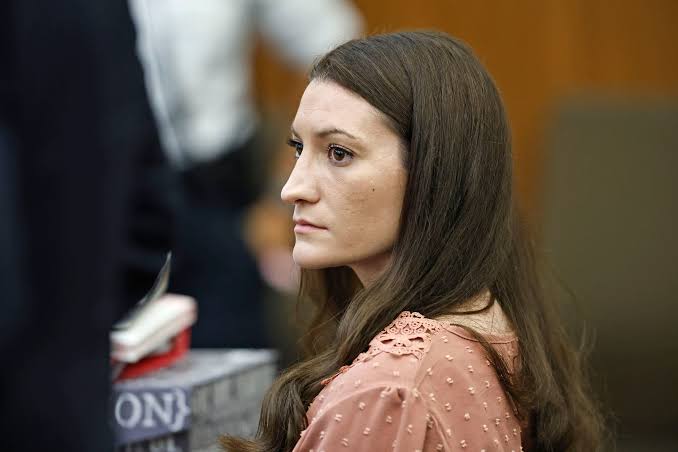
Please note: this reflection is not about whether or not Lindsay Clancy should be found criminally responsible for strangling to death her three children. At time of writing, her trial has just been ruled a mistrial since the jury could not reach a unanimous verdict. I am, of course, not in possession of all the testimony given in court and, although I have my opinion about the degree of her legal responsibility, that is not what I am concerned with here. I am not writing as a jurist on a particular case but as a theologian offering a prophetic critique of our current western culture.
Serial murder, though horrific and tragic, is not extraordinary in America. America is not Mayberry, that idyllic town of Andy Griffith and sadly, serial murders do take place here. What is extraordinary is the immense impassioned wave for support for Lindsay Clancy, especially on the part of women on the political left who declare their solidarity with her and profess great sympathy for her, saying that they too have been tempted to do such things.
Such women are, it seems clear, confusing post-partem depression (which is not uncommon) with post-partem psychosis (which is uncommon). Clancy’s defense lawyer is not arguing that she murdered her children simply because she suffered from post-partem depression. Many women suffer from such depression, but it does not tempt them to carefully plan and carry out the serial murder of their children. Her lawyer is arguing that she murdered them because she was suffering from a clinical psychosis, not the common post-partem depression. (Note: it is a further question whether suffering a psychotic episode means one does not have control of one’s actions.)
Since presumably adult women even on the political left can distinguish between a hormone-caused depression and an actual psychosis, their declarations of solidarity for Clancy are all the more extraordinary since they involve ignoring this distinction between depression and psychosis. This distinction they sweep aside in their rush to embrace her and to affirm that they too were tempted to do the same, even though (one hopes) they were never actually tempted to serially strangle their own offspring. The rush to embrace Clancy and to make her their righteous “cause” is done even at the cost of leaving behind such basic psychological discernment.
Such distinctions do not matter to these women; all that matters to them is sister solidarity with a woman who is being blamed. Because she is perceived as a woman under threat, other women rally around her, regardless of the court evidence. Some of those doing the rallying absurdly insist that she did not kill her children when in fact her defense team admits that she did. They need her to be innocent since she is their latest “cause”. That is why one commentator suggested that Clancy was the O. J. Simpson of white liberal women. Here we see tribalism in its most primitive form.
Clancy is being painted as the true victim in the case despite the fact that she strangled her three children, ages five, three, and eight months using exercise bands. We may ask therefore: what’s going on? One can of course sincerely conclude that Clancy was not criminally responsible for the deaths because of a psychosis. But such a belief does not explain the immediate growth of a large movement of support, and the fact that Clancy has become a celebrity, and the apparent eclipse of grief for the murdered children themselves. Quite apart from Clancy’s mental state and the final result of any future trial, this rush to embrace requires thoughtful explanation. How did we get to this place? I suggest it is the result of a convergence of three things.
First of all, as Pope John Paul II famously observed, America and the West generally have for generations been engulfed by a culture of death. As a part of this, abortion is now a normal part of western culture. How normal? Well, according to the Guttmacher Institute, an estimated 1,126,000 clinician-approved abortions occurred in the United States in 2025—and those are just the ones reported.
Women on the political left have sacralized abortion and even made it something to celebrate (one sees women wearing t-shirts with the words “I had an Abortion” proudly displayed). Such women are committed to absolving mothers who kill their unborn children in the womb of any blame. In their universe, the killing of unborn children brings no moral guilt.
The Clancy murders find their place on this continuum of death. And the question presents itself: if children may be blamelessly killed within the womb because the mother cannot bear to give birth to them and raise them, can a mother be blamed for killing her children in their rooms because she cannot bear to keep them?
The parallel is not exact, but we must recognize that the whole question of Clancy’s legal guilt or innocence is being considered from within a culture of death that normalizes and absolves mothers from killing their children. Death by individual strangulation is of course more vivid and visible than death by the methods used by abortionists where the deaths cannot be observed since they occur within the mother’s womb. That is why the Clancy murders are producing more indignation than the deaths caused by abortion. But either way, the Clancy killings occur within a culture which has dulled its conscience to the killing of children.
Secondly, our culture has arguably lost “evil” as a defining moral category. And with this loss of evil as a moral category, we are reduced to regarding evil acts as evidence of insanity. Ted Bundy, we feel, must have been insane. Hitler, it is often argued, must have been insane. But Hitler was quite sane. He was also evil and deliberately chose to do things which we rightly regard as morally horrific.
We see this knee-jerk substitution of insanity for evil even in such rock music songs as Aerosmith’s “Janie’s Got a Gun”, one of the lines of which reads, “Tell me now it’s untrue, what did her daddy do? He jacked [original lyric: “raped”] a little bitty baby; the man has got to be insane”.
Insane? No, just evil. But our culture reflexively transposes “evil” to “insanity” because the former category is no longer understood. Secular culture is reluctant to call anyone evil and so another explanation for evil actions must therefore be found.
With the loss of this fundamental moral category, our moral sense has been dulled and the Clancy case is being conducted within this changed culture. Clancy cannot be evil because no one is evil now. She might, however, be insane.
Finally, we note the polarized binary obtaining among those of the left: there are but two categories— oppressors and the oppressed, perpetrators and victims. Those who are white, “straight”, or male automatically fall into the former category; those who are black, gay, or women automatically fall into the latter. There are exceptions of course: if a black is a conservative, their victimhood status is in jeopardy; if a woman is a Christian, her victimhood status is also questionable. But basically, these categories hold and constitute the lens through which reality is experienced by those on the left.
Feminism, created and promoted by such women as the late Gloria Steinem (who aborted the only child she ever conceived), is heir to this destructive binary. It regards men as the enemy and sees evidence of oppression by the evil “patriarchy” everywhere. Feminism sets women against men, regarding them as natural enemies. In this tribalistic binary, women are taught that they are morally required to support Clancy regardless of her actions simply because she is a woman and is therefore being oppressed by men.
That is why, for example, Timothy Jones Jr. who murdered his five children in 2014 and pleaded “Not Guilty by reason of insanity” was convicted and sentenced to death by a jury after deliberating for only two hours. Men throughout the country did not rally to support him as women did for Clancy. Because Jones was a male, he was not a fit candidate for victimhood. Women are by definition victims and so therefore cannot be perpetrators. The binary of oppressors and victims, already ascendent and assumed in our culture, went to work instantly in the Clancy case.
None of all this, let me repeat again, declares one way or another for the criminal guilt or otherwise of Lindsay Clancy. But the characteristics of our culture that we have examined here help to explain the groundswell of support for her and the celebritization of her person. The Clancy case throws into high relief the characteristics of this sick age— an age we must understand if we would live within it and seek spiritual health as the faithful disciples of Jesus Christ.

About Fr. Lawrence Farley
Fr. Lawrence currently attends St. John of Shanghai Orthodox Church in North Vancouver, BC. He is also author of the Orthodox Bible Companion Series along with a number of other publications.