
I have just finished reading the excellent and admirably honest autobiography of Anthony Hopkins entitled We Did OK, Kid. Hopkins seems to have been (he is still alive) one of those people who grew wiser, better, and kinder with age. Throughout the book, however, I thought I could discern a life suffused with loneliness and sadness.
Hopkins would, I think, not disagree. He was not shy about sharing his personal philosophy of life or his feelings. One passage, taken from the final chapter of the book, represents much of his philosophy and feeling.
He writes, “In a recurring dream, I’m standing on a shaky battlement. There’s no way off it except but some rough, crumbling steps. I think How did I get up here? And how am I going to get down? The quiet experience daily, even with the aches and pains of aging, is the aloneness of my inner life… It is not just a spot of fanciful dream dust— it is real and located in the center of my body. I can describe only as sadness. Not a sweet ‘poor me’ sadness; perhaps not even sadness, but something that pushes me onward to the end of the road. Perhaps it is a mixture of love and grief, the ground of all being.”
This feeling of sadness in the center of his body, at the core of his being, is reflected in the many poems he valued and recited throughout his life, a collection of which forms an appendix to his autobiography. What they all have in common is a focus on death as extinction (a view of death shared by his father and his grandfather), death as the tragic annihilation of an individual and of life’s value.
So it is that we find in the appended collection of poetry Seneca’s poem “Soon we will spit out life’s breath” which ends with the words, “The moment we turn and look behind us, Death stands right there”.
The extended quotation from Shakespeare that Hopkins chose was the passage that began, “O, that this too, too solid flesh would melt, thaw and resolve itself into a dew!” (from Hamlet). He also chose a passage from Shakespeare’s Cymbelline the first stanza of which begins, “Fear no more the heat o’ the sun” and ends with the line, “Golden lads and girls all must, as chimney-sweepers, come to dust.”
From Christina Rossetti’s poem Remember: “Remember me when I am gone away, gone far away into the silent land…If the darkness and corruption leave a vestige of the thoughts that once I had, better by far that you should forget and smile than that you should remember and be sad”.
The sole quote from the Bible is from Ecclesiastes 1:5, 9, 11 which includes the line, “Nor will there be any remembrance of things that are to come by those who will come after”.
This last is particularly significant. Given the immense amount (one might almost say ‘overwhelming’ amount) of Biblical material celebrating hope, joy, and eternal life, Hopkins’ selection of this brief and uncharacteristic text is all the more remarkable. But it was this bit of Bible that found an echo and resonance in his heart.
In Hopkins’ last chapter he concludes by citing the first two stanzas of A. E. Housman’s Is My Team Plowing and said that its meaning and understanding deepened for him every year. It is a lovely poem, worth quoting at least in part:
“Is my team ploughing,
That I was used to drive
And hear the harness jingle
When I was man alive?”
Ay, the horses trample,
The harness jingles now;
No change though you lie under
The land you used to plough.”
The message is clear enough: death conquers all and the world goes on, not heeding or noticing our departure, and not leaving a trace of us behind. It is the timeless voice of the world’s grief and of universal human despair.
The point of this blog piece is not to focus upon, much less judge, dear Anthony Hopkins. I only quote his words because they seem to me typical of the hopelessness and despair that sits quietly and unexpressed in the heart of many people, the lovable, perplexed, struggling, and worn-down mass of humanity which crowds our cities and fills the buses of our daily commute. It can be expressed with bittersweet beauty or with brief and profane dismissiveness. I remember seeing an example of the latter on a bumper sticker which read, “Life’s a bitch. Then you die”.
Of course the multitudes of people do not express themselves as poetically as did Housman, Seneca, or Shakespeare. In fact, many in our secularized society— maybe even most—try not to confront the silence and void within. They leave it alone, undisturbed, unacknowledged, a sleeping dog that lies curled up and quiet. They run from the gnawing emptiness that whispers in the morning’s wee hours that too soon all will end in death. We turn on Netflix and run to TikTok to drown it all out; we lose ourselves in our smartphones and spend hours scrolling past nothing to avoid the nothingness at our center.
It was to these dear people— confused, weary, maybe hardly daring to hope— that the Gospel was addressed. The Church has good news for those people, the good news that life need not be miserable; it need not be (as a Buddhist in Hopkins’ book said) “one long goodbye”. There is not only a faint hope: there is the certainty of triumph and joy, the final wiping away of tears, an eternal song, sung with abandon in a day that will know no evening.
The world first caught sight of this hope in a Jewish cemetery outside the village of Bethany. A man sickened and then died and was buried. He had been rotting for four days with a nauseating, gagging putrescence. His sisters languished tearfully nearby, their hearts bidding him one last farewell. Then a Man stood just outside his tomb and ordered that the stone blocking it (and keeping in the overpowering stench) be removed. After a brief prayer He lifted up His voice and cried, “Lazarus, come forth!”
And then, death seemed to work backwards. The process of decay wherein his too solid flesh had melted, thawed, and resolved itself into a dew stopped and reversed itself and the man, still bound by the funeral bandages of death, stumbled out into the daylight to resume his life and plow again with his team.
It was a prophecy and a promise. Just before the Man struck death on its snout and forced it to disgorge its prey, He promised one of the sisters that what was about to happen to their brother would eventually happen to everyone and that those who followed Him need not fear death or live with sadness at their center. He said, “I am the resurrection and the life. He who believes in Me, though he die, yet shall he live, and everyone who lives and believes in Me shall never die.”
That is good news indeed for weary modern man. The leaden echo of sorrow and loss is here swallowed up and shouted down in the golden cry of triumph, the smackdown of death that Lazarus and his sisters first heard in that Jewish cemetery. We who believe in Jesus and who follow Him hold that cry like a promise in our hearts, in the center of our beings and bodies. We express it every year at Pascha celebrating the day when God’s Messiah trampled down death by His own death. Now He lives and bestows eternal life upon all His followers.
Not for us, therefore, lamentation of life lost forever. The moment we turn and look behind us, we do not see Death, but the Lord who has trampled death underfoot. Life is not one long goodbye but offers an encounter with the Lord.
If our autobiography included a collection of poetry, the collection would breathe a different spirit. And it would, I suggest, contain psalms like Psalm 84 which express what it means for us to be alive. Please allow me to conclude with a partial citation of those beautiful words.
“How lovely is Your dwelling place,
O Lord of hosts!
My soul longs, yes, faints
for the courts of the Lord;
my heart and flesh sing for joy
to the living God.
Even the sparrow finds a home,
and the swallow a nest for herself,
where she may lay her young,
at Your altars, O Lord of hosts,
my King and my God.
A day in Your courts is better
than a thousand elsewhere.
O Lord of hosts,
blessed is the one who trusts in You!”
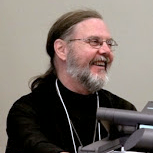
About Fr. Lawrence Farley
Fr. Lawrence currently attends St. John of Shanghai Orthodox Church in North Vancouver, BC. He is also author of the Orthodox Bible Companion Series along with a number of other publications.