
Time to climb aboard our time machine and leave the year 2026 for a time over a thousand years before Christ, the time when Eli was high priest in Israel during the period of the Judges (read all about in 1 Samuel). The land is in turmoil yet again: the Philistines immediately west of us are threatening attack and everyone is afraid.
The term “Philistine” now denotes an uncultured person, someone who is (one online definition tells us) “indifferent or openly hostile to art, culture, and intellectual pursuits, often focusing instead on materialistic values”. That definition would’ve surprised the ancient Israelites who knew only too well that their hostile Philistine neighbours were both culturally, technologically, and militarily far their superiors. In any confrontation or face off between Philistine and Israelite, the Israelites were bound to lose. That was why during the time of Eli everyone was afraid.
In those days Samuel was leading Israel as the last of its judges and “Israel went out to meet the Philistines in battle and camped beside Ebenezer while the Philistines camped in Aphek” (1 Samuel 4:1). The day was desperate and so, as a sign of the desperation, Israel decided to bring the Ark of the Covenant out from its shrine in Shiloh to lead the Israelite army in battle as a kind of talisman (think “Indiana Jones’ view of the mountain-levelling Ark”). The people shouted with a deafening whoop when it came into the camp. But God’s Ark was not given as a talisman nor as a guarantee of victory if victory was undeserved. The result was tragic: “the Philistines fought and Israel was smitten and everyone fled to his tent and the slaughter was very great. And the Ark of God was taken” (1 Samuel 5:10-11).
Note: “And the Ark of God was taken”. This was a worse catastrophe by far than the military defeat itself for it jeopardized the future presence of Yahweh in their midst and with it, their national unity and their very national existence. The Philistines, for their part, treated the Ark as a trophy of war and placed it in the temple of Dagon their god as a monument to Dagon’s power and his superiority over the Hebrews’ god.
But, as the Biblical text goes on to relate, Dagon in fact had no power or superiority over Yahweh the God of the Hebrews and when the Philistines of Ashdod went to Dagon’s temple the next day they found the statue of Dagon had fallen, prostrate on its pagan face before the Ark of Yahweh. The text relates (a comedic touch!) that “they took Dagon and set him in his place again”. Poor little Dagon! Fallen down and can’t get up without help!
The next day it was even worse. They found Dagon (i.e. his statue) again fallen face down before Yahweh’s Ark but this time the head and hands of Dagon had been cut off. Yahweh had apparently executed Dagon as a king would execute a prisoner of war!
There was more: on that day a plague broke out in Ashdod and its territories so the men of Ashdod sent the Ark (with what explanation) to their Philistine neighbours in Gath, hoping for relief. But, unsurprisingly, the plague then spread to Gath as well. Gath then sent it to Ekron, presumably because Ashdod refused to take it back. The people of Ekron, having seen what happened in Ashdod and Gath refused to accept delivery. The city’s rep said (one imagines rather with some heat), “They have brought the Ark of the God of Israel around to us, to kill us and our people!”
They quickly figured out the obvious— that Yahweh was not happy that His Ark was residing in the cities of Israel’s enemies and that Dagon and the gang were powerless to do anything about it. They therefore decided to send it back to Israel where it came from, hoping that Yahweh would relent and leave them alone. They then packed the Ark on a new cart pulled by two brand new milch cows and sent it back down the road leading to Israel, containing as a kind of apology to Yahweh golden tokens representing the penitence of the Philistine confederation of cities.
Eventually, after an unfortunate sojourn in the Israelite town of Beth-shemesh, the men of that town sent the cart with the Ark to neighbouring Kirath-jearim and the town prospered because of their piety and the presence among them of the Ark of the God of Israel.
What and where was Kiriath-jearim? The old name of the town was “Kiriath-baal” (i.e. “the village of Baal”) and “Baal-judah” (i.e. the site of a shrine to Baal in Judah), presumably because a shrine of Baal, the god of storm, rain, and fertility, was located there (see Joshua 15:60, 2 Samuel 6:2). The town’s name was changed to “Kiriath-jearim”— i.e. “the village of the woods”, doubtless to avoid association with the Baal cult. It was about sixty stadia west of Jerusalem, or in modern terms, about 8 miles.
And where, you may ask, can you find Kiriath-jearim today on the tourist map? As with any geographical question relating to the Holy Land, there are of course a variety of answers. But the smart money identifies it with modern Abu Ghosh, named (believe it or not) for an early brigand who made his headquarters there in the 19th century. The story is told that when he was a young missionary, a man named Gobat once encountered the notorious bandit and pleaded with him to repent and give up his evil ways. The robber heard out the priest very courteously but declined to change his ways. He did, however, assure him of his good will, and afterward, when Gobat had become the bishop Jerusalem, Abu Ghosh presented him with a silver vase as a gift. Anyway, the modern town of Abu Ghosh was named after the brigand.
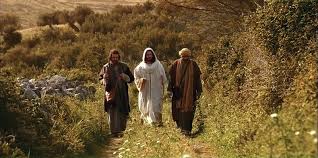
More importantly, the town of Abu Ghosh was once known by another name: Emmaus. (The word possibly means “bath”.) The town was once used by Roman legionaries as a kind of retirement village and Roman remains can be found there, along with relics of the Tenth Legion who in 70 A.D. destroyed Jerusalem and who were then stationed in the area. Readers of this blog will remember that it was in the village of Emmaus that the risen Christ revealed Himself to two of His disciples after walking along the road with them (Luke 24). The road to Kiriath-Jearim was the road to Emmaus. The Lord’s disciples, in walking the road from Jerusalem to Emmaus were making the same journey in reverse that King David did when He brought the Ark from Kiriath-jearim (i.e. from “the woods”; see Psalm 132:6) to Jerusalem.
How astonishing that the village where lay the Ark, the symbol and manifestation of God’s presence in Israel, should later be the same village which saw the presence of the risen Lord, Himself the incarnation and manifestation of the Father among men! In the very place where Yahweh rested after revealing His power over His Philistine foes the Lord Jesus rested after revealing His power over His foes on the cross (Colossians 2:15). Cleopas and his companion, walking the road as evening approached, were unknowingly walking towards a revelation of their Master’s risen glory.
Furthermore, we might consider that our whole life is one long journey along the road to Kiriath-jearim, the road to Emmaus, for at journey’s end we also will find the Lord manifesting Himself to us— this time not in humility as He reclined at a humble supper table, but in glory as He rests upon a heavenly throne at the right hand of the Father. For us it is a longer road than the sixty stadia from Jerusalem to Emmaus but when we finally reach our destination, no doubt battered and bruised, we shall find the long journey worthwhile.
The last word about the town may go to Leslie Farmer, whose book We Saw the Holy City, provided some of information found here. He wrote, “The Kiriath-jearim of the Old Testament is the Emmaus of the New. That is a parable. Where rested the Ark which for them of old was the Presence of the Lord, there came One who makes known to men, even to weary travellers, the eternal living Presence on every road, in every village, at every table, for those with eyes to see and hearts to love.”
God bless you all! Christ is risen!

About Fr. Lawrence Farley
Fr. Lawrence currently attends St. John of Shanghai Orthodox Church in North Vancouver, BC. He is also author of the Orthodox Bible Companion Series along with a number of other publications.