
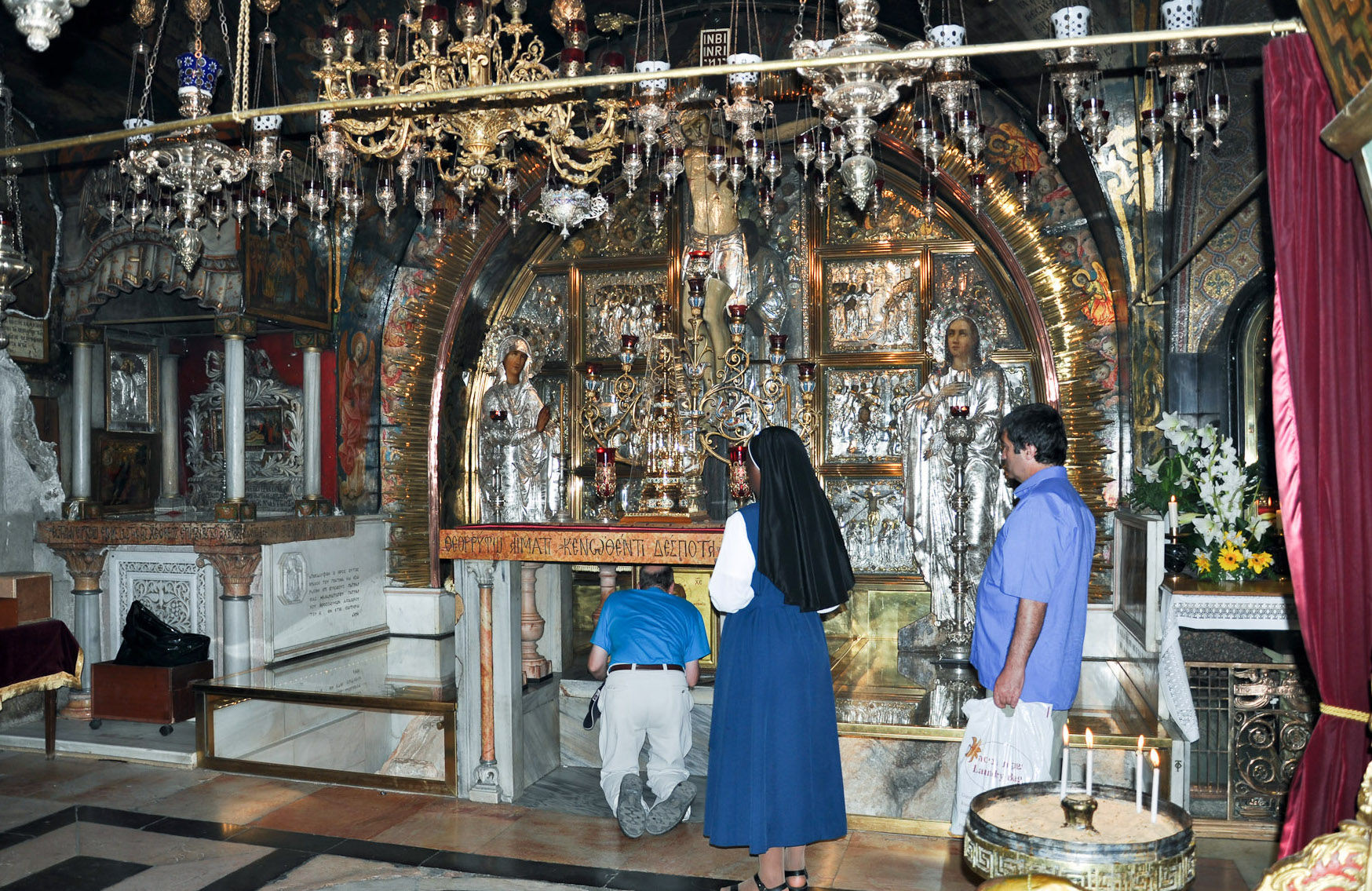
In a wonderful old book by Leslie Farmer published in 1944 entitled We Saw the Holy City (mentioned briefly in last week’s blog), Farmer tells a story about how he led a group of soldiers on leave during the Second World War to the church in Bethlehem at Christmas time. The Reverend Farmer was assigned to Jerusalem as the Methodist Army Chaplain for two years during that war and through exploration and scholarly research he got to know many of the places of pilgrimage in Jerusalem and throughout the Holy Land very well. Besides his pastoral duties to the sick, he also spent much time talking to soldiers on leave passing through the city and would lead them to the holy places and explain their significance.
So it was that he led a group of soldiers on Christmas Eve to the Church of the Nativity in Bethlehem. He explained to them the history of the place and of the building, including the grotto or cave in which Christ was born beneath the high altar. It being Christmas Eve, the church was packed to the doors. One of Farmer’s soldiers asked why there was such a big and noisy crowd and Padre Farmer explained that the crowd had gathered early and was waiting until midnight for the Christmas Mass. The man was incredulous. “Is that all?” he said. Farmer was flabbergasted and responded, “All! Pontifical High Mass by the Latin Patriarch! What more do you want?” The man replied (honest soul that he was) “A good Methodist service!” For him, a Pontifical High Mass by a papist patriarch was hardly something to wait around for hours to attend. Give him a good Methodist service every time! That might be worth waiting for!
I mention this little anecdote because it brings into high relief the subjectivity of Christian devotion. Farmer was a man of breadth of mind (as one can see from his answer to the soldier), but he was also a man who was formed in the liturgical traditions of British Methodism. Methodists thought that the Church of England was a bit too stuffy and formal for their liking and the Catholics were completely over the top with their bowing and scraping (I have heard the term used as late as the 1970s), and their lacey surplices, their incense, their statues and their pictures. The Methodist reaction to the many Orthodox shrines would have been even more pronounced, for in them they would have found something quite foreign to all they had known and loved. It was unfamiliar to the point of jarring.
We see this in Farmer’s reaction to the grotto beneath the Church of St. Anne’s in Jerusalem, purported to be the birthplace of the Virgin Mary. Farmer was impressed by the beauty of the church itself (“Only in Abu Ghosh have I seen anything approaching it in grace and dignity”) but the grotto itself was something else. “It contained”, he wrote, “a tawdry altar with many geegaws all round.” (Later he also wrote about “the garish crudity of the Holy Sepulcher” and of “tawdry ecclesiasticism”. Yep: he was a Methodist.)
I admit that I had to Google the word “geegaw”. The Cambridge online dictionary informed me that it meant “a small decorative object or toy, usually one with no real value”.
This was, of course, in the early 1940s and there is now no way of knowing how it differed then from the lovely grotto chapel one can now view online. And I am unclear what Farmer meant by “geegaws”— candles? Ribbons? Banners? Icons? Rosaries? What is clear is that what he saw left him cold devotionally and jarred with the reputed sanctity of the place. Perhaps he would have preferred “a good Methodist shrine”?
I mention this reaction of a dear and devout man because his attitude to the current décor adorning the holy places can be found in many people today, especially Protestant visitors to the Holy Land. They come to the holy places which they have read about all their lives and which have long existed in their pious imaginations. They see in their minds the “green hill far away outside a city wall” which is Calvary; they see in all its undisturbed peace and sanctity the quiet and isolated garden tomb from which Christ arose; they see in their hearts every Christmas the nativity creche standing in a wooden stable, with the shepherds and the wise men and the angels— and then they come to the Holy Land on tour to find these things which they have always loved.
And their encounter with those things at their current sites is emotionally jarring. For one thing, the creche or birthplace of Jesus in Bethlehem was not set in a wooden stable as modelled by their Nativity sets, but in a cave. And the cave is full of… well, geegaws: a plush altar, many hanging lamps, a silver star set into the floor— with Latin words! The green hill far away outside a city wall is now inside a city wall. And it is not a hill, green or otherwise, but a chapel entered by a series of steps (see inset image above). And again with the geegaws! An altar, pictures (i.e. icons), candle-sticks— nothing like the wind-swept hill outside the city that they pictured.
The same with the garden tomb: it is now not in a garden but in the middle of a confusing church, with candles and pictures. And all around, both in Bethlehem and at the Church of the Holy Sepulcher, the crowds! Line-ups and jostling and foreign voices— all of it nothing like they imagined it would be. No wonder, I was told, that after visiting the Church of the Holy Sepulcher some Protestant pilgrims went to the Garden Tomb outside the city to sit there in the quiet, preferring this as the site of the Tomb of Christ to the traditional one within the city walls. Indeed, some people suggest that Catholics accept the Holy Sepulcher as the authentic site and Protestants the Garden Tomb. (Farmer, it must be said, did not accept this, and was clear that the Church of the Holy Sepulcher was the authentic site.)
But one can understand how some Protestants prefer the Garden Tomb as the authentic site. The traditional site is so jarring, so full of liturgical and devotional items (those geegaws again) which are totally foreign to them and which they feel have no place there. Whereas the Garden Tomb site is so— well, unspoiled, so unchanged, so exactly like it was in the first century (supposedly) and like they always imagined the place of Christ’s burial would be. Scholarship such as Farmer presented is so complicated and complex. One is more easily guided by emotional considerations. And the Garden Tomb is so peaceful… If only one could find a similar such alternative site in Bethlehem! I do understand the Protestant preference for the unspoiled site that is the Garden Tomb.
The fly in the emotional ointment is the flow of history, all that complicated and complex stuff that scholars like Farmer lay out. I understand, I really do, after travelling great distances to the Holy Land at great expense the desire to find it all as expected— simple, unspoiled, unchanged from the first century as if the first Christians and all the Christians ever after had left the site of the garden tomb untouched, along with the place of Christ’s Passion, and the cave in which He was born. Then those visiting in the centuries to come could arrive and find it all in its pristine simplicity— a green hill, a quiet garden, a barren cave, all exactly as they imagined it, and their devotional piety could feed upon the holiness of the sites and picture Christ there.
But let’s be honest: that is not how people behave, then or now. Archaeologists point out that people in the past had a complete disregard for the supposed sanctity or historical importance of stone and site. There are countless examples of peasants taking away the stone of an historically important pagan temple or a ruined Christian church and using it to build their own houses— much to the frustration and horror of scholars and archaeologists who would love to see such temples and churches preserved or at least put into museums. How could you possibly pillage such a beautiful temple of Diana, they demand, pulling out their hair, and use it to enlarge your own little hovel? But the peasants didn’t care about the historical significance of the temple of Diana; they just wanted somewhere to live with their families. People gotta live somewhere!
And so we must acknowledge that if the Christians did not build a shrine over the cave in which Christ was born or a church enclosing the site of His crucifixion and tomb, those sites would not have remained in pristine condition awaiting future Christian pilgrims. They would’ve been used for secular purposes instead and where the Church of the Holy Sepulcher now stands (destroyed by Muslims, by the way, and later rebuilt by Crusaders) we would not now find a green hill and a quiet garden, but modern office buildings and shops, with the holy sites buried ten to twenty feet underneath.
I suggest therefore that we may heartily thank our Christian forbears for their devotion which led to them building shrines and churches at the holy sites. Of course they adorned them as they then saw fit— not with bare church walls and an occasional plaque with a Bible verse, but with altars and candle-sticks and icons and lamps— and geegaws. That was how they thought a church should look if it was to provide “a good Orthodox service”.
And we may be glad that they did. Or would one prefer that the holy sites were lost forever, buried underground and covered by the debris of centuries, and in its place over top of it a glitzy and high class “Zion Shopping Emporium”? Or the oh-so fashionable “Bethlehem Boutique”?

About Fr. Lawrence Farley
Fr. Lawrence currently attends St. John of Shanghai Orthodox Church in North Vancouver, BC. He is also author of the Orthodox Bible Companion Series along with a number of other publications.