
In the Protestant Evangelical world the priest (sorry: “the pastor”) is not a figure of authority within the local church community but is primarily a preacher, an administrator. He can be available for counselling, if necessary. In large mega-churches he functions as a CEO. But he is not a figure of authority within the church; anyone can disagree with his sermon, his Biblical exegesis, and his doctrine in the same way as they would disagree with any Christian. The Evangelical version of the Reformation doctrine of “the priesthood of all believers” effectively functions to deprive the pastor of most of his traditional presbyteral authority.
It is otherwise in the Orthodox church where the priest is a figure of authority. That is the point of the universal honourific “Father” used when referring to him. Strictly speaking the term does not denote a priest or presbyter; a holy lay monk could be so termed. But such is the esteem with which the parish priest is held within his congregation that the term is always used and is expected. Indeed, I would suggest, the real point of the honourific title is that the main task of the parish priest is to create a vibrant and healthy family out of the gathering of his parishioners and to function among them the way that a father functions in his biological family.
So then, what is the authority of the priest in his parish? How does the healthy exercise of authority look? Four Biblical texts are relevant here.
One is Hebrews 13:17 which reads, “Obey your leaders and submit to them, for they keep watch over your souls as those who will give an account”. That is, the leaders (in that day, the council of presbyters working with the bishop who functioned as the local liturgical celebrant) had the responsibility for keeping peace and unity in the church community. Unruly, fractious, wicked, or heretical persons were to be admonished, warned, and then if they refused to repent, expelled (see 1 Corinthians 5:2, 13, Titus 3:10-11). The text from Hebrews 13 encourages the laity to let the presbyters do their job which is keeping the peace and teaching the faith.
Another text reveals how that pastoral and presbyteral authority should work. In 1 Thessalonians 2:6-8 St. Paul describes his work among them in this way: “We did not seek glory from men, either from you or from others, even though as apostles of Christ we might have asserted our authority. But we proved to be gentle among you, as a nursing mother tenderly cares for her own children. Having so fond an affection for you, we were well-pleased to impart to you not only the gospel of God but also our own lives, because you had become very dear to us.”
Here we see what true fatherly authority looks like— i.e. it looks like the gentle love of a nursing mother for her own babies. In particular it involves laying aside a concern for honour, obedience, and deference, not seeking such glory or aggressively asserting one’s authority. If the apostles could lay aside such demands, how much more the leaders under them?
The third text is from the Lord Himself. In Mark 10:42-44 the Lord said to the apostles, “You know that those who are recognized as rulers of the Gentiles lord it over them; and their great men exercise authority over them. But it is not this way among you, but whoever wishes to become great among you shall be your servant; and whoever wishes to be first among you shall be slave of all”. He confirmed this teaching on His last night with His apostles when He washed their feet and told them that this was to provide an example for them: authority was to be exercised through humble service (John 13).
The apostles took this to heart. That is why St. Peter, in writing to the presbyters in the churches said, “Shepherd the flock of God among you… not as lording it over those allotted to your charge but proving to be examples to the flock (1 Peter 5:2-3).
Here we see that the shepherds are to resist the temptation to act superior to their flock, strutting and demanding honour and submission as if they were lords. Rather, they should become examples of humility, washing the feet of those allotted to them as their servant and slave.
One final text, that of Matthew 23:8-11. It forms part of a dossier of divine denunciation as our Lord insists that His disciples exercise authority differently than did the Pharisees. He said, “Do not be called Rabbi; for One is your Teacher, and you are all brothers. Do not call anyone on earth your father; for One is your Father, He who is in heaven. Do not be called guides; for One is your Guide, that is, Christ. But the greatest among you shall be your servant. Whoever exalts himself shall be humbled; and whoever humbles himself shall be exalted.”
Here we again see that humility is the prerequire for exercising authority. Christian authority is built on the foundation of a prior and more fundamental equality: before one is a father, one is a brother. All Christians share a common brotherhood, offering their ultimate submission to Christ and God the Father.
This means that there can be no blind obedience in the Church. No priest should consider himself beyond critique or challenge from his brother parishioners. A priest is not a guru. Unquestioning obedience and submission were the marks of a Jewish disciple to his Rabbi in our Lord’s time but He said that it was not to be so among His disciples. The priest is not set over his parishioners but among them.
This is an important lesson for today. Many new converts are surging into the Church from secular society, especially young men who are tired of hostility to authority and the absence of discipline. Some are hungry for certitudes and nervous of ambiguity, desirous for black and white declarations and suspicious of grey complexity. They prefer the quick assurance that comes from fundamentalism; they are impatient with the slow and painful work of scholarship. Such converts gravitate to men who assert their authority, men who demand obedience because of their office and prefer legalism to discernment. Men who relish texts like Hebrews 13:17 and who ignore its spiritual foundation in texts like Matthew 23:9.
It is important for the future health of the Church that its future leaders remember and embody all the Bible texts regarding the exercise of authority and regard themselves as brothers and servants of their parishioners. If not, the next generation will see the growth of a generation of legalistic Pharisees, spiritual infants incapable of Christian maturity.
A parish priest must be a brother before he is a father. He must love his parishioners with the same humble love with which a father loves his own children. It is as the Lord said: the good shepherd lays down his life for the sheep.
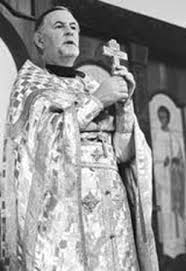
The fact is that truly holy priests do not require or seek such overweening authority or blind obedience. This was apparent from a story I once heard about Fr. Alexander Schmemann (inset) from Fr. Alexis Vinogradov (shared with his permission) with which I will close.
One day Fr. Alexander was relaxing with his family at their country cottage, playing volleyball with his extended family, wearing shorts and a tee-shirt. Young Alexis who then served as an altar boy approached him and, cupping his hands in the usual way, asked for his blessing, saying “Bless, Batushka” as if he were in church. Fr. Alexander, rather than give an ecclesiastical blessing, took the boy by his shoulders, kissed him on his forehead, and simply said, “Here among my family I am called ‘Uncle Sasha’”.
The boy was surprised and later related how this simple declaration removed a whole weight of religiosity and clericalism from his young shoulders, revealing what true priestly authenticity looked like. As Fr. Tom Hopko once said, Fr. Schmemann delighted to be seen among his lay people. As we can see from the example of “Uncle Sasha”, a holy priest is first of all a man among men.
Note: My latest brief interview is available on Youtube at: https://www.youtube.com/watch?v=oZISyGgZsrY
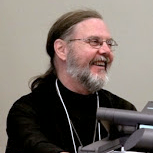
About Fr. Lawrence Farley
Fr. Lawrence currently attends St. John of Shanghai Orthodox Church in North Vancouver, BC. He is also author of the Orthodox Bible Companion Series along with a number of other publications.