
Readers of this blog may not be familiar with the Homoeans which would be quite understandable for they all died out centuries ago. Now they can only be discovered within the pages of church history books, but they were all the rage in the fourth century. Let’s review.
In the fourth century the presbyter Arius of Alexandria vexed his bishop by teaching that the pre-existent Word or Logos who became incarnate in Jesus Christ was a creation of God and therefore not truly divine. God created/ begat the Word (Arius used the two terms interchangeably) before time began and then through Him created the world. Thus, there was a time before time when the Word did not exist and it was only after God begat/ created Him that God became the Father. The Word could be called divine or “God” only in a derivative or honourary sense. It was in this way alone, Arius thought, that the Church’s monotheism could be preserved. If the Word was truly God, then God’s unity (and thus monotheism) would be compromised for that meant that there were two Gods. Therefore only the Father was truly God.
This made sense to lots of people and so Arius’ teaching spread like philosophical wildfire throughout the Church, especially in the east. It was so divisive that the Emperor Constantine called a council to sort out the whole thing and preserve the Church’s unity. A council was held in Nicea in 325 A.D. which condemned Arius and produced the Nicene statement (later used as a creed at Liturgy) as a test of episcopal orthodoxy. At Nicea, if a bishop wanted to remain a bishop, he had to sign on to the Nicene statement which affirmed the full divinity of the Word, including the then-controversial word homoousios, meaning “consubstantial” or “of the same essence” and confess that Christ was of the same essence as the Father.
The word homoousios had a shady past and was used by a condemned heretic but it was used by him in another sense completely. It was, however, the only word that the followers of Arius couldn’t twist to suit their own meaning. At Nicea, every bishop had to accept the Nicene statement with its homoousios or he would be deposed and exiled.
But accepting this teaching at Nicea while the Emperor was there and selling it to everyone back home were two different things and a number of people back home thought that the word did not do sufficient justice to the distinction between the Father and the Son and of the subordination of the latter to the former. Of course, the word was never intended to express that teaching but only the complementary teaching that, distinct and subordinate as the Word was to the Father, He was still as fully divine as the Father. The whole issue was complex and nuanced and complicated and not all the bishops were (shall we say) keen intellects. Some had trouble “getting it” and so the controversy continued for decades after Nicea.
Bishop Athanasius (who was a deacon when the council was held) was, in fact, repeatedly condemned and exiled before the whole controversy was through. Council after council was held in an attempt to find a formula that everyone could agree upon and thus preserve the unity of the Church. Many people were prepared to anathemize Arius (who was too radical for all but a few) but they still had trouble with the homoousios of the Nicene statement. That was why other councils were held to try and hit upon a better formulation than that of Nicea. For example, how about homoiousios, meaning “of like essence”? That would seem to leave room for a subordination of the Word to the Father while still honouring the Word.
Like I said, not all the bishops were keen intellects. The problem with homoiousios was that it seemed to suggest that one’s ousia or nature could be semi-divine. The category of semi-divinity might fly in paganism (a number of pagan emperors were considered to have been divinized after their death and ancient guys like Gilgamesh were regarded as partially divine, having a divine and a human parent) but not in Israel. In Israel (and therefore in the Church) the separation between Creator and His creation was infinite and absolute. One could not be semi-divine or sort of God or “God-ish”. Either one was the uncreated Creator God or was part of His creation. No middle ground was possible and so the notion of “like essence” was nonsensical. Either one’s essence was completely divine or completely created. It was really only a choice between Arius or Nicea but this insight took time to develop as the Church tried out many different formulas.
In the middle of the fourth century, one of those formulas was the Homoean formula which simply said that the Word was “like the Father”. As the acrimonious division between many bishops dragged on interminably with no end in sight, some felt that the only way forward was to avoid all talk of ousia/ essence and unite around the confession that the Word was “like the Father” and leave it at that. This was so popular that hundreds of bishops, both east and west, signed on. Most of them rejected Arius (who insisted that the Word was unlike the Father) but they felt that unity was more important than almost anything else. As long as Arius was gone, surely that was enough? Why prolong schism in the Church when we could have unity by simply avoiding the question of Christ’s nature/ essence altogether?
One Council that pushed the Homoean formula was the Council of Sirmium in 357 A.D. It forbade talk of substantia/ ousia (especially denouncing the term homoousios) and stressed the superiority of the Father to the Son. (Later Nicene Christians would refer to their statement as “the blasphemy of Sirmium”.) It took time and the indefatigable labours of St. Athanasius and his supporters for the Nicene cause to triumph (and with it, clear thinking). Today we recite the Nicene Creed (which incorporates a later series of statements about the Holy Spirit, formulated in 381 A.D. in Constantinople) and easily forget how spectacularly explosive those Nicene words formulated in 325 A.D. once were.
This, of course, is now so much water under the ecclesiastical bridge. So why mention it now? Because the Homoean temptation to avoid precision in the service of church unity is still with us.
Today we have what seems like gazillions of church denominations. That is embarrassing enough but it was even worse many decades ago for denominational diversity created acrimony and family division. In those days, if a Presbyterian married a Baptist or a Methodist became an Episcopalian (or—horrors!—any Protestant converted to Roman Catholicism) it was considered a scandal and a calamity for the families involved. The offenders had breached decency and family loyalty and were ever after regarded as something like outcasts. And the polemical warfare waged by the denominations against one another was not pretty.
No surprise, therefore, if thoughtful souls strove with all their might to find common ground and unity. The present World Council of Churches (now much changed from its original state) began as a sort of inter-denominational Protestant truce to help work on the mission field. One can therefore appreciate their desire for unity.
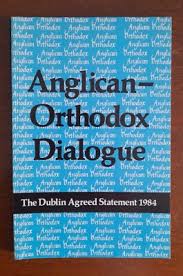
This laudable desire for unity which was the original impetus of the ecumenical movement has produced many so-called “agreed statements”—i.e. statements about controversial matters which formerly separated denominations. We find agreed statements issued jointly by the Anglican Church and the Roman Catholic Church, between the Anglican Church and the Orthodox Churches, between Orthodox Churches and the Roman Catholic Church, between Anglicans and Lutherans, between Orthodox and the Reformed, between Anglicans and Methodists and between Evangelicals and Catholics. It was considered to be the only way forward which is why (as we used to protest to our mothers), “Everybody’s doing it”.
The trick was to find language to which both parties could agree and to omit statements with which one of the parties could not agree. It was unity through formula (like the Homoeans of the fourth century): both parties could agree with the actual words of the statement, even if both parties really interpreted those words somewhat differently. The agreement over the words were trumpeted as progress; the remaining disagreements, including the disagreement about the actual issues under discussion, was quietly dropped—or at least left unspoken until the other parties went home and we could talk about them in their absence.
And there was more fun, because the ecumenists agreeing with the ecumenists of other churches did not necessarily agree with the other ecumenists of their own church. So, for example, the pro-Orthodox Anglicans were agreeing with the Orthodox while other Evangelical Anglicans were agreeing with the Methodists and the sets of agreed statements produced by the two groups were completely incompatible. One sees why ecumenical dead ends were reached so quickly.
Over against all this, the Orthodox Church insists that unity must be based on truth and compromising the essentials is not the path forward. We could, of course, all have complete church unity by next Thursday if all Christians would agree that doctrine and practice didn’t matter and the only thing that counted was good will. There was even an ecumenical slogan promoting this: “Doctrine divides; service unites”. But the Church, in the fourth century as now, rejects such an approach.
That is what the Church meant when it asserted that it was “apostolic”—i.e. not just that it had been founded by the apostles but that its teaching remains that of the apostles. St. Paul said it long ago: “Guard the deposit” (2 Timothy 1:14).
We will therefore take a pass on ecumenical Homoean agreed statements that use fruitful ambiguity to secure verbal agreement where no real agreement actually exists. At the end of the day such agreements are little more than pieces of paper and like everything else on the Last Day they will enter the fire of testing (1 Corinthians 3:12-15). If the words on the paper do not conform to the apostolic deposit, they will be burned up.
The desire for unity is still a godly desire and we should still strive to overcome barriers and to find our unity in the truth of Christ. Alas, the path forward into true unity is arduous and long and there are no Homoean shortcuts. All the more reason for us to talk calmly with our fellow Christians and pray and look to the Lord to one day bring us together.
About Fr. Lawrence Farley
Fr. Lawrence currently attends St. John of Shanghai Orthodox Church in North Vancouver, BC. He is also author of the Orthodox Bible Companion Series along with a number of other publications.