
During the exchange of the Peace in the Orthodox Divine Liturgy it had been my custom to greet those around me by saying, “Christ is in our midst!”, expecting the reply (and giving as the reply when the greeting was given to me) “He is and ever shall be!” I was therefore quite surprised when the (now late) Fr. Michael Oleksa commented to me, “Actually, that’s not the correct reply: we should reply by saying, ‘He is and shall be”. I immediately looked it up in the service book and found (unsurprisingly, given Fr. Michael’s learning) that he was correct. But what’s the difference? And does it really matter? Isn’t it saying the same thing?
The difference between the two replies concerns the nature of Christ’s future presence. Fr. Michael’s point was that if I reply, “He is and ever shall be” I am saying that Christ is even now spiritually present in our assembled midst and that this will never change. Christ will always be spiritually present among us as He is now. That is true, I suppose, but the reply “He is and shall be” is saying something different.
Specifically, it is saying that Christ is now present spiritually in our midst but that after He returns at the Second Coming He will be present in our midst in His eschatological and consummating fullness. The first reply is a declaration of Christ’s abiding spiritual presence, a celebration of continuity. The second version of the reply stresses not continuity but contrast: Christ is present spiritually among us now but later will be present in the fullness of power in the age to come. The contrast between the two modes of presence bids us look to the horizon, to the eschaton, to the End, to the Second Coming and the age to come. It retains and expresses the eschatological nature of the Eucharist as the presence of the future, as an anticipation and taste of the age to come.
St. Paul said it first: in the Eucharist we “proclaim the Lord’s death until He comes” (1 Corinthians 11:26). The Eucharist does not just look back to the Last Supper, the Cross, and the Resurrection. It also looks ahead to the future, to the Second Coming. The anaphora makes this clear for it says that we “remember all those things which have come to pass for us: the Cross, the Tomb, the Resurrection on the third day, the Ascension into heaven, the Sitting at the right hand and the second and glorious Coming”. A note of eschatological anticipation, a forward-looking focus, is embedded in the Eucharistic text itself.
It is just this eschatological focus that the Church sometimes tends to lose sight of, to its detriment. Especially during its Byzantine phase when the Emperor exerted such a powerful presence (causing many to imagine that “the Emperor is in our midst: he is and ever shall be”) some were tempted to equate the Christian empire with the Kingdom of God. Indeed, towards the end of the Christian empire in the east a patriarch of Constantinople bid his Russian brothers to pray for the Emperor because it was impossible, he said, for there to be a church without a Christian emperor running it. The events after 1453 would prove him wrong. But in fairness to the patriarch, that was how it seemed to many people in his day.
A focus on the eschaton and the Second Coming, though central to the thought of the apostles in their New Testament letters, has in the past led to embarrassment so that many want to steer quite clear of it today. One remembers the followers of William Miller in the 1840s who fervently believed his prediction that Christ would return on October 22, 1844. Indeed, many of them ascended to the roofs of their houses to wait for it and October 23 was a dark day for them. One also remembers the repeated dates set for Armageddon by the Jehovah’s Witnesses throughout the twentieth century. And one remembers more recently the confident predictions— a number of them!— of Harold Camping. He first set the date for Judgment Day on September 6, 1994 and then, after that date passed unremarkably, again on September 29, and then again on October 2. Camping apparently was not one to be deterred and so after about a decade, in 2005, he set yet another date for the End on May 21, 2011. After this day passed with nothing much happening, he later admitted ruefully in an interview that he didn’t think that anyone could predict the date of the Second Coming. Good call, Harold. Maybe he had finally read Mark 13:32.
Such missteps are not confined to what I would characterize as the Evangelical lunatic fringe. When times become uncertain and chaotic, and everything seems to be in a state of increasing collapse, it is easy to see in such chaos signs of the approaching end. That was the view of St. Gregory the Great (d. 604) who lived in an apocalyptic time when the Roman empire (which for him, as for many, was equated with the world) was collapsing before barbarian pressure. St. Gregory was hardly lunatic fringe. But it is easy to conclude The End Is At Hand when all the previous cultural landmarks of peace, security, and sanity are being swept away.
All that said, we still need to heed the teaching that we are living in the last days (and have been since the Day of Pentecost; see Acts 2:17) and even in the last hour (see 1 John 2:18). Living eschatologically doesn’t involve— and must not involve— setting dates for the Second Coming or working ourselves into a flap over political events as if they were infallible harbingers of the approaching End. Living eschatologically simply means living in a state of spiritual readiness for the Lord’s Return so we will not be caught sleeping (1 Thessalonians 5:6). It means realizing that we belong ultimately not to this age but to the age to come and that our true citizenship is not with any earthly nation, but the Kingdom of God in heaven (Philippians 3:20). The cry of Marantha!— Aramaic for “our Lord, come!”— must ever be in our hearts.
Perhaps one reason why we find this cry foreign to us is not just rooted in the exploits of lunatic fringe like Miller, the Jehovah’s Witnesses, and Camping. Perhaps we sometimes find life here too comfortable to focus for too long on the horizon from which will come the Saviour.
Sergius Bulgakov (d. 1944) certainly thought so. In his essay on The Apocalypse of John he wrote that “the fire of faith which this prayer [i.e. “Maranatha!”] expresses has completely gone out in us. We never use this prayer of prayers. It is not in our Prayer Books. We pray to the Holy Spirit to ‘Come and abide in us’. We are up to that, because we understand this as His partial coming, as His gracious help in our infirmity— which help, however, leaves us essentially as we were before. But by the prayer to our Lord Jesus, ‘Even so, come!’, nothing half-way is meant”. Elsewhere in his short but powerful essay he spoke of how the Church “has ceased to think about the Parousia” [i.e. the Second Coming]. Instead, he wrote, we “have found refuge… in the all-sufficient grace of the sacraments, as if that grace were not a call but a kind of pleasant sedative”.
We must not misunderstand Fr. Sergius. He was not denigrating the power of the sacraments or criticizing the prayers in the Prayer Books. Rather, he was calling those who communed and prayed to recognize the Eucharist and the life of prayer as a call to total commitment to the Lord, to the eschaton, to the age to come, and to let the prayer “Maranatha!” burn in their hearts. Fr. Sergius’ world was not our world (he was born in 1871) and his fiery and prophetic critique of the lukewarm nominalism which sees in the services of the Church “a kind of pleasant sedative” does not apply to our day as much as it did to his. But even so his prophetic fire may still warm and illumine our hearts.
Maybe that was Fr. Oleksa’s point. Fr. Oleksa was not liturgical pedant but rather a man of God, an evangelist, a man in whose heart also burned the prayer of fire, “the prayer of prayers”. Christ is indeed now in our midst. One day He will return and shall be with us in power, bringing all the cosmos into submission to the Father. Christ is among us and shall be! Maranatha!
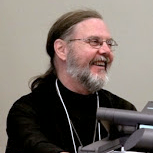
About Fr. Lawrence Farley
Fr. Lawrence currently attends St. John of Shanghai Orthodox Church in North Vancouver, BC. He is also author of the Orthodox Bible Companion Series along with a number of other publications.