
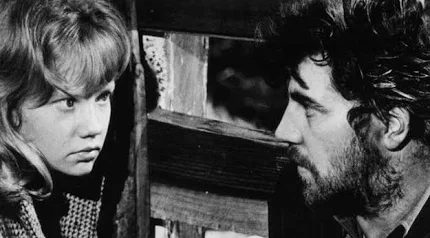
Lately, through the kindness of a friend, I watched recently an old 1961 British film starring a very young Hayley Mills entitled Whistle Down the Wind, dating from before her Disney days (see inset above). I saw it as a young child when it was first released in movie theatres and re-watching it as an old man I found it had lost none of its magic. (Although this time, obviously, I was no longer infatuated with its young star as I was when I was seven years old.) The film in its entirety can be watched here.
The film, written by Mills’ mother, focuses upon a fugitive, a man who had murdered someone in Lancashire and had escaped arrest and who was hiding wounded in a barn. While hiding there and suffering from his wound, he was found by the daughter of the man who owned the barn, a young and (as it turned out) tragically naïve girl named Kathy, played by Hayley Mills. She asked him who he was and, suffering immense pain, just before fainting, he uttered the profanity “Jesus Christ” and then collapsed unconscious. The young girl understood this as his answer to her question and she and her two younger siblings promptly believed him to be Jesus Christ. Absurd as the premise sounds when stated so summarily, such was the writing and acting and the age of the children that it made perfect sense and sounded perfectly credible within the context of the film.
The man’s behaviour (such as his inability to keep alive one of their kittens which the children had given into his care) caused one of the children to doubt and to conclude “It isn’t Jesus. It’s just a fella”, but Kathy kept faith and refused to believe that it was not Jesus. She was, however, perplexed about how Jesus could have let her kitten die after He was given it to look after.
Naturally, good C. of E. child that she was, she found asked the village Vicar why it was that this happened, without of course revealing that she had Jesus staying in her barn. Her question was more timeless and universal than she knew: she was really asking not just about one kitten but about mortality in general. She therefore asked the Vicar why, if Jesus healed so many people, He let so many others die. The Vicar, God bless him, was more than a bit surprised and stymied and he mumbled something about there being not room for everybody in the world unless some people died and quickly moved on to the topic of human evil and how people did bad things— a much worse problem as far as he was concerned, especially since his church buildings were suffering some vandalism from young people.
As Kathy left with her brother, the young boy quietly stated the obvious about the Vicar and the problem of suffering and said to her, “He doesn’t know, does he?” Kathy shook her head. No, he doesn’t.
Despite the fact that the Vicar comes off like a bit of an idiot, one cannot but feel sympathy for him, for all clergy have been asked questions that they cannot answer and which in fact cannot be answered— and not just about the death of pets but about the question of human mortality and the sometimes tragically unfair and untimely death of loved ones. If we pretend that we can adequately answer the question and thereby assuage the suffering of the human heart, our inadequacy will be revealed soon enough. The person may thank us for our response, but they will know we have failed even if they are too polite to say so. As they leave, they will silently say to themselves: “He doesn’t know, does he?” No, no we don’t.
That is why it is always better not to pretend. In their love for their flock, pastors of course want to be helpful and to ease pain and that can sometimes lead them (especially young pastors) to attempt an answer a question which they cannot answer— and which most of the time cannot be answered. The hope is that if they can just provide a full and correct theological answer to the stated question of why God allowed their loved one to die, that would somehow lessen the pain.
Alas, it is not so. The questioner is not looking for a theological truth or an convincing theodicy. They are looking for the comfort of knowing that their pain is shared and that they are loved. And perhaps— just perhaps— that their pain will somehow and some day go away. The pastor can offer assurance that for the Christian all pain will one day vanish and that every tear will one day be wiped away, that they will inherit a world in which there will no longer be any death or any mourning or any crying or any pain and that such things will pass away (Revelation 21:3). We can offer the assurance that the present darkness is just the middle, not the end. But explaining why such things happen is beyond us. We can hold and hug and pray. But in all this we must still confess our ignorance. Why did my kitten die? Why did my father die? Why did my child die? We don’t know, do we? No, but we can still trust.
And it is this trust which leads us ultimately through the darkness to the light, out of pain and into peace. Jesus does care for kittens and for all of us. Meanwhile, suffering remains an impenetrable mystery and in the face of it we can only bow in worship before God and trust Him as He takes our hand to lead us out of our darkness into His light.
Sometimes a book on suffering may help. Please allow me to commend Prayers in the Dark, written by myself and available from Ancient Faith Publishing in time for Great Lent. May it prove a blessing to you. A description can be found here. The book can be ordered here.

About Fr. Lawrence Farley
Fr. Lawrence currently attends St. John of Shanghai Orthodox Church in North Vancouver, BC. He is also author of the Orthodox Bible Companion Series along with a number of other publications.