
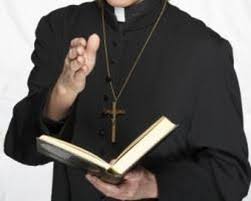
With the expected influx of ordinations to the priesthood hoping to keep up with the recent surge of new converts coming into Orthodox parishes, many new priests will be stepping into pulpits (metaphorical or otherwise) to preach. Given the importance of preaching in the life of a parish (St. John Chrysostom knows what I mean), I am surprised at how comparatively little importance it is given in some places. When I was in seminary back in the Jurassic period we had many, many classes on the Old and New Testament each year, many offerings of Church History, many classes in Theology, but only one class on Homiletics. One asks: what’s the point of learning all that other stuff if you can’t effectively share it?
I remember that in another seminary the sermon was delivered by students while the clergy communed in the altar behind closed Royal Doors so that the sermon was, in effect, simply “filler”.
Given such minimalism, I would like to say a word about preaching, having done it for many decades.
There are, of course, many different styles of preaching, many ways of preparing a sermon, and many suggestions about what preaching is and how to preach. This is mine.
First of all, it should be understood that preaching a sermon is not at all the same thing as “giving a little talk”. A talk is usually something plain, informal, seemingly off the cuff. And a sermon is not a lecture, which suggests something longer and more formal, something to be read from a page, sonorous, maybe even ponderous, and a touch academic. A sermon or homily (I use the terms interchangeably) is neither of these.
A sermon is a kind of prophecy, a message from God. Its goal is not to inform as a talk or lecture informs but to inspire, to inflame, to illumine, to change lives, and as such it partakes of all the characteristics and verbal drama of classical rhetoric. As a rhetorical performance, it should reach a verbal dramatic climax so that the congregation can tell when the sermon is coming to its conclusion. It should leave the people moved: the prophetic word was described in Jeremiah 23:29 as a fire, as a hammer that shatters a rock. A sermon should be like that.
Secondly, a sermon should be something the preacher receives from God, a message put into his soul in words of fire. The homiletic word is like a fire in the mouth of the preacher (Jeremiah 5:14)— or more specifically, a fire kindled by the Holy Spirit in the heart of the preacher. The task of the preacher is to let this fire proceed from his heart through his mouth and find its fiery way into the hearts of the people.
My own practice each week in preparing the sermon for Sunday was to leave the house and go for a walk and seek God, asking Him to give me a word, a message, something to give to my people that Sunday. It consisted of meditating on the Sunday Gospel or lesson, letting my mind revolve restlessly around it, waiting for the Lord to speak. Sometimes the message would come in the middle of night and I would arise from bed, creep towards pen and paper, and scribble down what I was given so that I would remember it the next morning. Having received the sermon, the task then was to go over it in my mind and preach it to myself a time or two to prepare for Sunday’s delivery.
Note: this means that the sermon does not consist of the preacher’s opinions, ideas, suggestions, or notions. It consists of the Word of God. The preacher is not really the author of the sermon but merely a delivery boy, a messenger.
That means, of course, that the sermon must be delivered with authority. The sermon is not offered as a subject to be debated but as the Word of the Lord to be received and behind it is the unspoken introduction, “Thus saith the Lord”.
We find this in the words of St. Peter: regarding verbal spiritual gifts he writes that “as each has received a χάρισμα/ charisma, use it to serve one another as good stewards of God’s varied grace. Whoever speaks, let him speak as one who speaks the oracles of God” (1 Peter 4:10-11). The words rendered “the oracles of God” is the Greek λόγια θεοῦ/ logia theou, the same words used by St. Paul in Romans 3:2 to describe the Scriptures.
Not, of course, that the preacher’s words have Scriptural authority! St. Peter was referring to the speaker’s boldness, not the content of his message. The preacher is not sharing his thoughts; he is proclaiming what God has given him. (Which means, I hasten to add, that he must be very sure that God has given that message to him!)
Thirdly, the message must be centered around Scripture, explaining, explicating, and applying its meaning to the lives of the hearers. The sermon is therefore a bridge, starting from the Scripture and leading to the lives of the hearers. One can start at either end of the bridge: one can start with the text and apply it to the people’s situation or one can start with their situation and then apply the text to it. But either way the text will be central.
This means, fourthly, that the preacher must know the meaning of the text. Indeed, a priest should be so soaked in Scripture that he knows and can cite the text cold. My old homiletics prof counselled us to read the text in several translations and then look it up in several commentaries. I assume that the preacher already knows the text inside and out— preferably in the Greek. As another old prof once said (tweaking his words), “You should learn Hebrew if you can and Greek whether you can or not”. (He was my Old Testament prof so he naturally gave Hebrew and not Greek pride of place. But the Gospels and New Testament from which the Sunday lessons come are in Greek.)
The Sunday sermon is not, of course, a Bible Study and the preacher cannot exegete the text in the same careful and detailed way that he would in a Bible Study. But he must make the text live in all its richness— which in the case of the Gospel lessons means explaining what the cultural details meant in its day— so that the hearer is transported from the present pew into the world of the Gospel. You may park your car in North Vancouver, New York, London, or Tokyo for the Liturgy but at sermon time you must be in first century Palestine.
Fifthly, this means that the preacher should not use notes. Notes are like the training wheels on a bicycle— useful and necessary when you are just learning to ride, but to be removed as soon as possible. (I will, however, admit to sometimes having a scrap of paper stored in my pocket with my three sermon points scribbled on it in case I go blank. It functions as a kind of security blanket in case of emergency.)
The problem with using notes is that one almost inevitably relates to the notes on the lectern when preaching and not to the people assembled to hear you. That works for a talk or a lecture, the aim of which is to inform, but not for a sermon the aim of which is to inspire and transform. For the path of the transforming fire is through the eyes— the divine fire burns in the preacher’s heart and comes out through his eyes as he speaks, going straight into the eyes of the hearers and down into their hearts. Making the notes one’s attentive focus tends to short-circuit this whole process. (Reading from the text of the Bible is the exception that proves the rule for a preacher reads from the Bible not to remember what to say but to fill up with more fire.)
It is true that reading from or consulting a text can make for more polished content. But the aim is not elegant prose or poetic eloquence, but the fire of the Spirit. What counts is sincerity, animation, excitement of heart— for how can one not be excited when transmitting the Word of God? St. Paul said the same: “And I, when I came to you, brothers, did not come proclaiming to you the testimony of God with lofty speech or wisdom. For I decided to know nothing among you except Jesus Christ and Him crucified. And I was with you in weakness and in fear and much trembling, and my speech and my message were not in plausible words of wisdom, but in demonstration of the Spirit and of power, so that your faith might not rest in the wisdom of men but in the power of God” (1 Corinthians 2:1-5). The preacher should choose power over polish every time.
Finally, every sermon should have some practical application to one’s life. The hearer should be able to say, “This sermon helped me in my spiritual walk with Christ”. My old homiletics prof, when looking at the manuscripts of the sermons we submitted to him, would sometimes write “SW” at the end of some of our sermons, which was an abbreviation of “So What?” Every sermon should have “so what”, a practical application. If not, it has not done its job.
I conclude by saying that there are few things more satisfying to a priest than preaching and delivering to the people he loves the transforming fire of the Word of God. And also, nothing more dangerous. His words are delivered (or should be delivered) right after the words of Christ read in the Gospel. The preacher thus dares to add to Christ’s words— daring indeed for the fallen children of men! But that is the preacher’s task, a task given him by God through ordination in the Church. Tremble, preacher! For on the Last Day God will ask for an account of your preaching and what you dared to say in His name.
About Fr. Lawrence Farley
Fr. Lawrence currently attends St. John of Shanghai Orthodox Church in North Vancouver, BC. He is also author of the Orthodox Bible Companion Series along with a number of other publications.