
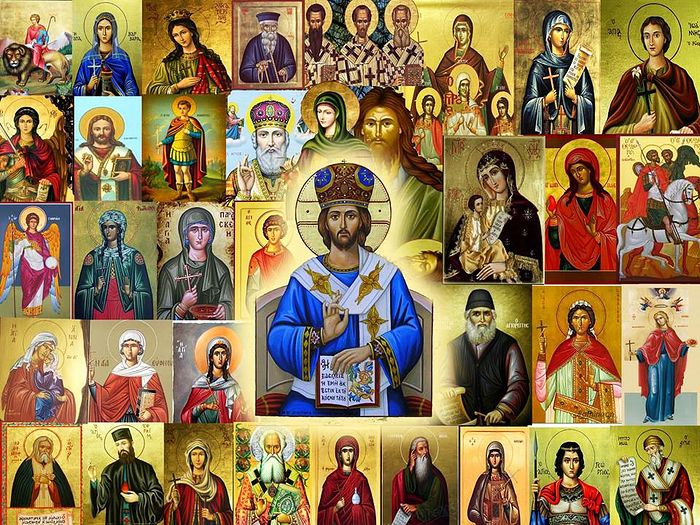
For some people, the significance of the saints is that of mediators, those who stand between us and God and through their prayers reconcile us to Him and sanctify us. In this way of thinking, Christians are primarily sinners who need to be saved and sanctified, who need a connection with the holy so that they can go from being guilty and profane to being forgiven and holy. The saints, in this setting, provide just this connection. (We note in passing that this mindset tends to forget such texts as 1 Timothy 2:5 and to confuse a mediator with an intercessor. Any Christian, including a saint, can intercede for someone else; Christ alone reconciles us to God.)
The categories basic to this understanding of saints as mediators are “profane” and “holy” and the job of the Church, it is understood, is to repeatedly help Christians to go from the first category to the second. It does this in many ways: multiplied Liturgies, the kissing of relics, and asking for the prayers of the saints. The saints’ job in heaven, it is thought, is to assist the Christian on earth, bringing him from a profane state to a holy one.
Things such as attending services, kissing relics, and asking for a saint’s intercession are good, of course, but it is possible to make use of them forgetting their true setting and as part of a different set of categories. For the basic categories of the Christian faith are not “profane” and “holy”, but “old” and “new”, “this age” and “the age to come”. Christ, crucified, risen, and glorified, is the abiding embodiment of the latter category; He is the new age, the Kingdom of God, the transforming immortality of the age to come. The Church is His Body and is itself therefore also the “new aeon”.
Fr. Alexander Schmemann was quite clear about all this. He wrote that in paganism, “the basic idea was the distinction between the profane and the sacred and, consequently, the understanding of the cult as primarily a system of ceremonies and ritual which transmitted sacredness to the profane…The pagan mystery was basically just such a consecrating and sanctifying act… We know that Christianity set itself in opposition to the mystery religions on this point. It professed salvation not as the possibility of an individual deliverance from evil and sin but proclaimed it as the eschatological fulfilment of the history of salvation, as the event leading man into the Aeon of the Kingdom of God... [In the fourth century] what was changed was not worship itself in its objective content and order, but rather the reception, the experience, the understanding of worship” (from his Introduction to Liturgical Theology).
What Fr. Alexander perceived and rejected here was not just the pagan split between the sacred and the profane, but also the deeper root of the split. He perceived the underlying falsity of the pagan vision of salvation as an escape from creation and saw that Christ revealed that salvation involved not an escape from creation but rather its transfiguration as the spiritual invaded the created reality, and heaven literally came down to earth. The pagan split between a good spiritual world and a tainted earthly world was a symptom of its underlying failure to see that God had pronounced His creation to be “very good”. As one wise man commented, “the whole arc of Scripture moves towards the renewal of all things, not flight from them. The saints witness precisely to this: that holiness transfigures the material world rather than abandoning it”.
One sees why this shift of understanding happened in the fourth century. The Church was struggling to preserve its holiness— indeed, its eschatological character— in the face of a surge of new pagan converts entering its life. (One notes with sympathy that the Church in the fourth century had more than enough on its plate even apart from the surge of new converts, as it strove to find a way to express its corporate mind to the Emperor and to deal with distortions of that mind such as Arianism.) With this understanding of salvation and Christian cult as a way of sanctifying the profane, it is not surprising that the saints were coopted to this project and seen primarily as agents of sanctification for the average profane believer.
But that is not how the saints were originally viewed. To quote Schmemann again from his Introduction, “the local character of the cult of the saints was preserved up to the end of the third century and the close connection between this veneration and the grave or body of the saint must be regarded as its essential and distinctive feature. It is an accepted fact that the early Church knew nothing of our distinction between glorified or canonized saints and ‘ordinary’ members of the Church. Holiness pertained to the Church and all those who constituted the Church were holy because they were members of a holy people. The setting apart of the bodies of the martyrs for special liturgical veneration was rooted therefore not in any specific opposition of holy to non-holy but in the early Church’s faith that Christ appeared in the martyr in a special way, bearing witness through the martyr to His own power and victory over death. The body of a martyr was therefore a witness left to the Church, a pledge of the final victory of Christ”.
Schmemann continues: “The supplication ora pro nobis (‘pray for us’) in the graffiti of the catacombs was addressed to all the faithful departed in the communion of the Church. Nor was it sanctifying in the sense of a sanctification of the faithful by way of touching the remains of the saint. It was sacramentally eschatological... In celebrating the Eucharist on the martyr’s tomb the Church confessed and revealed that she belonged to this new life”.
Schmemann is talking about the cult of the martyrs and their role in the life of the early Church, for the martyrs were the first Christians whose relics were venerated and who formed a special group within the Church. The cult of martyrs was at first local, as the local church (for example, in Smyrna) would venerate their own martyr (Bishop Polycarp of Smyrna). But soon enough Christians would venerate other martyrs as well from different locales as the stories of their martyrdom became more widely known.
And later other Christians came to be seen as especially holy, as “saints”, even though they had not been martyred, men who were hailed as exemplars, such as Saint Anthony of Egypt. The cult of the martyrs therefore came to include such men as well. A special place in the devotional hearts of the faithful was also held by Mary the Virgin Mother of Christ, from as early as the second century, and it soon to be followed by other Biblical persons as well such as the Old Testament patriarchs and prophets. Later famous men and women in the life of the Church were added to the devotional roster with the passing of years, exemplars such as St. Cyril of Alexandria in the fourth century and St. Olga of Alaska in the twenty-first.
And so it is to this day. Orthodoxy not only venerates and invokes the prayers of martyrs but also of Biblical heroes and prominent figures in the history of the Church. Their days of commemoration fill our church calendars and love for them fills our hearts. But how should be regard them?
It is just here that Fr. Schmemann’s historical reminders are so valuable. Of course we ask the saints we love and are devoted to for their prayers. We ask all our brothers and sisters in Christ, living or departed, to pray for us, whether or not we inscribe ora pro nobis on their headstones. All those who are in Christ are part of the Aeon of the Kingdom of God and those who have departed are at rest with their Lord in the Kingdom. Naturally they pray for us and naturally we ask for their prayers— and pray for them in turn, in death as in life. How much more will we also ask for the intercession of the martyrs and saints to remember us in their prayers for the Church?
Those prayers are not the means whereby the profane are sanctified by the holy, for those who are truly disciples of Christ are not profane. All members of the Church are holy. And this unity of all Christians with one another and with the Lord (sometimes called “the communion of saints”) is not broken by death.
As we pray for our brothers and sisters who are alive and they pray for us, so this glory-filled and transforming symbiosis of mutual intercession continues even after one person of the prayer fellowship dies. Living or dead, we continue to uphold one another as parts of the eschatological Body of Christ. Even now on earth, the Church participates in the powers of the age to come; even now we live in the Eighth Day of eternity, the place where eternity intersects with time. The martyrs and saints bore witness to this holiness and to the eschatological character of the Church, both by their lives and by their deaths. It is this realized eschatology that is manifested in the Church’s communion of saints, wherein everyone prays everyone else.
The saints therefore reveal the true eschatological nature of the Church as belonging not to this age but to the age to come. And because of this they also call and inspire us to follow them, recognizing that we also are to live as those who belong primarily to the age to come, living as strangers and sojourners on the earth. The saints are our friends and examples.
That is the true significance of the saints. They reveal to us who we really are as they help us in our journey to the Kingdom. We see this at every Liturgy: when the celebrant summons to the faithful to come and commune, he cries out, “The holy things for the holy!” or (in more Latinate language, “The sanctified things for the saints!”) He is not referring to those present who have behaved themselves in the past week. He is referring to all the baptized Orthodox present. As a part of the holy Church, they are holy, for their baptism united them with their holy Lord. As those united to Christ, we ask the saints in heaven are further along the path than we are for their intercession that we might persevere until we finally join them in the Kingdom.
Note: If you haven’t already seen it, you might be interested to watch my interview with my new Cloud of Witnesses friends. It is can be accessed here.
About Fr. Lawrence Farley
Fr. Lawrence currently attends St. John of Shanghai Orthodox Church in North Vancouver, BC. He is also author of the Orthodox Bible Companion Series along with a number of other publications.