
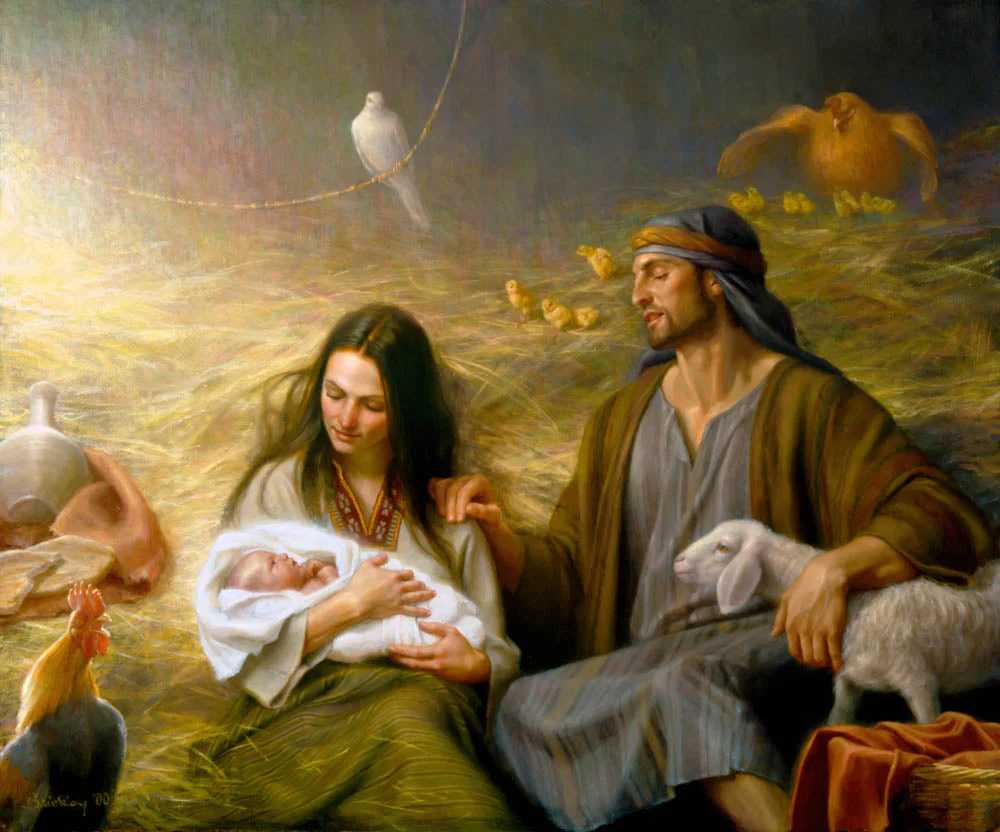
Odds are that if you began to talk about “kenosis” in a room full of strangers they would assume you were talking about a change in your metabolism. Nope: that’s “ketosis”, not “kenosis”. The term “kenosis” is a theological term used to describe the divine self-emptying that occurred at the Incarnation of the eternal Logos/ Word in the person of Jesus of Nazareth. We usually call it “Christmas”.
The classic text is Philippians 2:5f which reads, “Have this attitude among yourselves which was also in Christ Jesus who, though existing in the form of God, did not consider equality with God something to be grasped, but emptied Himself [Greek ἐκένωσεν/ ekenosen] by taking the form of a slave [Greek doulos] and being born in the likeness of men. And being found in appearance as a man, He humbled Himself by becoming obedient to death, even the death of the cross.”
The verb κενόω/ kenoo means “to empty” as well as “to render void”; in Mark 12:3 the adjective kenos is used to describe someone sent away empty handed. In our Philippians text the verb has sometimes been rendered interpretively: Phillips renders it “stripped of all privilege”; the King James renders it: “made himself of no reputation”; the NIV renders it “made himself nothing”. In all these renderings the notion of self-limitation is foremost.
One can immediately see why. As the pre-incarnate eternal Word, the Second Person of the Holy Trinity (to use later terms) He was omnipresent and could be found everywhere. As the incarnate Word, Jesus could not be in two places at the same time— if He was in Galilee, you couldn’t find Him in Judea. As the eternal Word, He was omnipotent and immortal; as the incarnate Word, He could become weak, hungry, and tired and could die. The incarnation therefore involved this voluntary self-limitation— indeed, the ultimate self-limitation: before He was in the form of God; then He was in the form of a human slave.
It would take the best minds of the Church a long time to hammer out the details of this kenosis and its implications for Christology. One brief clarification is found in the so-called “Athanasian Creed” (which was not written by Athanasius and was not a creed, but never mind). This western document says that the incarnation was “not by conversion of Godhead into flesh but by taking of Manhood into God”. That is, it was not like putting ten gallons of water into a one quart container. We see here that patristic Christology was exceedingly nuanced and complex which of course is why it took so long to create and refine.
I would like to suggest that the divine kenosis is the key to practically everything in the life of the Christian. Kenosis is what God does.
We see this in the original act of creation. Before the creation of the universe, God was everywhere present, filling all things. His will was sovereign and undisputed. To create the world He needed to withdraw Himself to create a space for world— not in the sense of being absent, for He continued to be present to His creation, being both transcendent and immanent at the same time. But in creating (for example) a human being with a free will of its own He condescended to limit His power somewhat. Now His will might be done by His created being or (as it turned out) it might not. In this sense He emptied Himself, making it possible for Him to be defied by the thing He had made. We therefore see in the acts of creation the humility of God who thereby made dialogue (and with it, contradiction and disobedience) possible.
We see this kenotic humility throughout God’s dealings with His people. Israel began to defy Him almost immediately: after He had liberated them from Egypt by the might of His outstretched hand, fed them with manna, and brought them safely through the desert to His holy mountain, they straightway rebelled against Him, making a golden calf to worship while Moses was away receiving the Law for them on the mountain. This disobedience continued, off and on (but mostly on) throughout their history, despite the pleadings of the prophets until their sins brought judgment and exile swept them away. In the words of Jeremiah 32:33, Israel turned their backs to God and not their face. And yet God continued to love them and brought them back from exile. And— more astonishingly as we read through the Old Testament and into the New— God would send His divine Word to dwell among them and even to die in disgrace and agony for them (and for all the world). The kenosis of the incarnation and the passion was merely the climax and full flowering of all of God’s kenotic acts.
As Paul told the Philippians in the passage cited above, God’s humility sets the pattern for ours as well. Christ took on the role of household slave at the Last Supper and washed the feet of His disciples, thereby giving us an example and commandment to wash one another’s feet in the same way (John 13:1f). The early Christians remembered this and obeyed, so much so that the pagans marvelled “Behold how these Christians love one another!” (thus Tertullian in his Apology, chapter 39).
Such kenosis is the basis of all true relationship and communication, whether it is between Christians or not. Truly listening to another person (i.e. not just waiting impatiently for a chance to speak) involves withdrawing from the dialogic pulpit and humbly trying to understand what the other person is saying and meaning. (I note in passing that this is almost never done on social forums such as Facebook.) Like God in creation, we withdraw to create a space for someone else to speak and (unlike God who has nothing to learn) we are open to being taught.
The opposite, of course, is a refusal to withdraw, a refusal to be silent, a refusal to be open to contradiction or learning. A spectacular (and lurid) example of this were the endless late night monologues of Adolf Hitler who regaled his hearers with his opinions until many of them fell asleep. The monologues were the fruit of megalomania, an ego which brooked no contradiction and which knew no limits. This megalomania made it impossible for him to withdraw and let others respond. The divine humility which Christ bid us imitate had no meaning for him.
But it means everything for us. It is by humility that we receive the gift of the apostolic Tradition which bestows on us the truths of our faith. We don’t have to dope stuff out by ourselves; instead we just open our hands, our minds, and our hearts to receive it all as a free gift. That is, we empty ourselves of our confidence to figure everything out. It is by humility that we continue to learn and grow in the Faith, for the Faith contains lessons that can only be understood with the passing of years. Having emptied ourselves to receive the Tradition, we retain a kenotic humility to help us slowly understand it.
Kenosis, therefore, is the key to spiritual growth and to everything. By it we imitate the Trinity: the Father who created the world through His Word and the Word who laid aside His divine form to live and die as one of us. In a sense even the Holy Spirit empties Himself, for when He comes He does not glorify Himself, but glorifies Christ (John 15:26, 16:13-14). In the words of Vladimir Lossky (in his Mystical Theology of the Eastern Church: “The third Hypostasis of the Trinity [i.e. the Spirit] is the only one not having His image in another Person. The Holy Spirit, as Person, remains unmanifested, hidden, concealing Himself in His very appearing” (italics mine).
We can see, therefore, how important is humility. God fully manifests His kenotic humility and condescension in all that He does. We must learn to imitate Him and cease to strut upon the earth or vaunt ourselves. The way home for us does not lie there. It is a lesson the Church throughout its history has learned (shall we say) unevenly. But the lesson retains its importance nonetheless. And Great Lent is as good as any time for us to learn it afresh.
About Fr. Lawrence Farley
Fr. Lawrence currently attends St. John of Shanghai Orthodox Church in North Vancouver, BC. He is also author of the Orthodox Bible Companion Series along with a number of other publications.