
In a previous blog piece I quoted from the third century document known as the Didascalia, part of which detailed the process whereby the bishop and the presbyters would hold weekly meetings for arbitration to resolve quarrels among Christians in the Eucharistic community. It was believed that congregational harmony was so important that such a process of resolution and reconciliation was needed to maintain the spiritual health of the local church community.
The writer of the Didache (a church manual written in about 100 A.D.) said the same thing. In chapter 14 of its instructions about the Lord’s Day, it says, “On the Lord’s own day gather together and break bread and give thanks, having first confessed your sins so that your sacrifice [i.e. the Eucharist] may be pure. But let no one who has a quarrel with a companion join you until they have been reconciled so that your sacrifice may not be defiled”.
Note: “that your sacrifice may not be defiled”. The Didache considered that an unresolved quarrel between church members “defiled” the Eucharist— a phrase meaning that its salvific effect would be nullified if the church was rent and wracked by mutual rancour. No wonder clergy from a later century took such pains to preserve the unity and harmony of church members.
We see this concern for harmony expressed in the exchange of the Peace. At some point in the Eucharist, the deacon would bid the people to greet one another, accepting each other in love and casting away whatever grudges they might have held.
This exchange of the Peace was no mere formality. In the ancient Liturgy of St. Mark, for example (the old Liturgy of the Church of Alexandria), it is preceded by a priestly prayer asking that the mutual salutation be authentic. After the deacon tells the people to greet one another, the priest then prays as follows that they may exchange the Peace in sincerity of heart: “O Sovereign and almighty Lord look down from heaven on Your Church, on all Your people and all Your flock. Save us all, Your unworthy servants. Give us Your peace, Your help, and Your love and send to us the gift of Your Holy Spirit that with a pure heart and a good conscience we may greet one another with a holy kiss, without hypocrisy and with no hostile purpose but guileless and pure in one spirit, in the bond of peace and love…”
We can see from this the great importance that the Church continued to place on congregational harmony. That harmony was not taken for granted or even left to chance. Rather, it was the object of priestly intercession as a prayer was offered each Sunday to ensure that the exchange of the Peace betokened true reconciliation, harmony, and love.
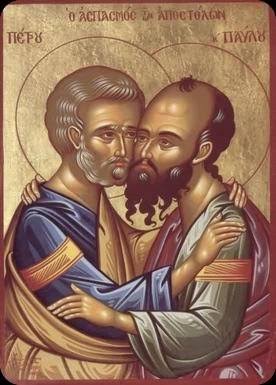
The exchange of the Peace has a long history. It is first mentioned by Paul in his letters which were of course read in the context of the Sunday Eucharistic assembly when all met together. He bids the assembled church to “greet one another with a holy kiss” in Romans 16:16, in 1 Corinthians 16:20, in 2 Corinthians 13:12, and in 1 Thessalonians 5:26. Peter says the same: “Greet one another with a kiss of love” (1 Peter 5:14). This shows that the liturgical kiss of peace was a part of Eucharistic worship from the days of the apostles.
That is why we find it Justin Martyr’s description of the Eucharist in his Apology, chapter 65, written in the middle of the second century. In it he describes what happens at the Christians’ worship. He informs his pagan readers that Christians interceded for the world and its needs and that “having ended the prayers, we greet one another with a kiss”.
Note too: St. Justin relates that the Kiss was given “having ended the prayers”. That is because it was considered that the Kiss sealed the prayers and made them effectual. The Christians, as the royal priesthood, offered the Church’s prayers for the world and it was their mutual love and harmony which made their prayers powerful. As one liturgical scholar said, “At every Christian synaxis [i.e. gathering]… [the Kiss] was the symbol of fraternal love that sealed the Christian service” (Taft, The Great Entrance”).
The exchange of the Peace continued long in the Byzantine Church, even to the 10th century. But by the 11th century, the Kiss began to be exchanged only by those in the altar, and a 13th century Georgian version of Chrysostom’s Liturgy prescribes that the priest, when serving alone without other clergy, simply omit the Kiss entirely, since there was no one else in the altar to exchange it with.
The Kiss or the exchange of the Peace continues to be found in our Orthodox service books. Just before reciting the Creed, the deacon calls out to the church “Let us love one another that with one mind we may confess Father, Son, and Holy Spirit, the Trinity one in essence and undivided!” After this, the concelebrating clergy in the altar obey the diaconal summons and exchange the Peace.
The question is: given the importance of unity and harmony in the congregation and given the long history of the exchange of the Peace, and given that the deacon addresses his summons to all the people and not just the clergy, why should the laity not exchange it among themselves in the nave while the concelebrating clergy are exchanging it in the altar? The greeting is not to be exchanged with everyone in the congregation but only with those standing next to them. Done in this way, the exchange of the Peace takes only a few moments. (I timed it once: it took about ten seconds).
In some Orthodox places today, the Kiss is now being restored (though not without the same controversy that once attended the restoration of more frequent Communion). Its restoration need not disrupt the service, nor degenerate into a kind of warm and fuzzy hugfest. But it remains important for it knocks down the walls and helps to knit together the assembled parishioners into a family, breaking the barriers which sin erects between brothers, preparing all to stand together as one body before the Holy Chalice.
As Fr. Alexander Schmemann wrote in his The Eucharist, “In our current, utterly individualistic and egocentric approach to the Church this rite is inevitably perceived as a hollow ‘form’: I really don’t know the man who is standing across from me in church, for he is a ‘stranger’ to me. We forget that in the call to greet one another with a holy kiss we are talking not of our personal, natural, human love, but of the love of Christ which transforms the stranger into a brother”.
Perhaps it is time to heed St. Paul’s letters, to heed our liturgical history, and to heed what the deacon actually says to us. Perhaps now is the time to cement our unity and seal our prayers with the Kiss.
About Fr. Lawrence Farley
Fr. Lawrence currently attends St. John of Shanghai Orthodox Church in North Vancouver, BC. He is also author of the Orthodox Bible Companion Series along with a number of other publications.