
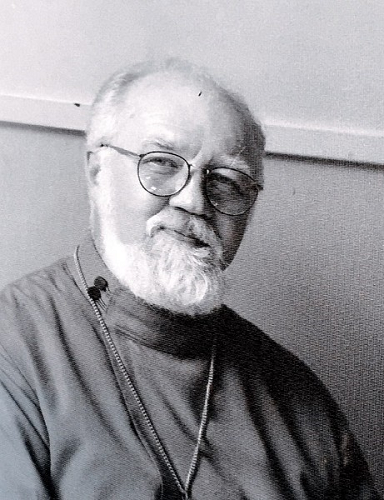
It was during the 1988 All-American Council of the OCA that I overheard Fr. Daniel Donlick (then Dean of St. Tikhon’s Seminary) comment to a group of worker priests (i.e. clergy who supported themselves and their families by working at secular jobs while serving parishes) “We must bow low before you worker priests for your dedication and the work that you do.” It was the kind and generous acknowledgment of a great and humble man. In like spirit, I would also like to bow low before Fr. John Scratch (inset above) at the twentieth anniversary of his repose on January 15 for his dedication and the work that he did— him and others like him in his generation.
Fr. John (or “Papa John” to those who knew him) was born in Alberta in 1941, the son of a well-known Pentecostal missionary. He married Suzanne Park in 1967 and then was ordained deacon and priest in the Anglican church in 1969, serving parishes in Quebec and Ontario while living in difficult financial circumstances. They had six children, two of whom (Gregory and Sebastian) later became Orthodox priests. Concerned about the direction in which the Anglican Church was headed, Fr. John (then known by his birth name of Fr. “Clare”) left the Anglican priesthood and was received into Orthodoxy in 1979, soon after being ordained deacon and then priest in the Orthodox Church. In 1980 he started a tiny congregation in Ottawa, Holy Transfiguration Mission, which met in the living room of a house. Papa John supported himself and his family by working as a security guard.
In 1987 his parish of Holy Transfiguration merged with the neighbouring parish of St. Nicholas Church to become the new cathedral for the recently-elected and consecrated Bishop Seraphim. The cathedral was called “Annunciation to the Theotokos-St. Nicholas” and Fr. Scratch was its dean.
In 1998 Fr. John’s wife Suzanne reposed and Fr. John was called out of retirement to Edmonton to serve St. Herman of Alaska parish there, sharing the work with Fr. Dennis Pihach. Papa John suffered a heart attack in 2002 and soon after returned to Ottawa to continue his interrupted retirement. He reposed in 2006, loved and mourned by all.
I had the privilege of meeting Papa John in 1985. I had just left the Anglican priesthood and been received into Orthodoxy in Toronto and was waiting there before travelling down to St. Tikhon’s Seminary in Pennsylvania with my wife and two daughters, aged one and three, in preparation for ordination to priesthood in the Orthodox Church. Papa John found out about us and knew that given our almost complete lack of parish experience in Orthodoxy we might well end up as lambs to the slaughter. So, at his own considerable expense, he got in touch with us and arranged for our first-class train tickets from Toronto to Ottawa and put us up in a hotel so that my wife and I could experience a new English language mission.
I remember that Liturgy and Papa John’s wisdom to this day. By anyone’s standards the mission was humble and small enough— just a dozen or so people it seemed (I didn’t count the numbers) singing in a living room around a makeshift altar. For some reason they got the music wrong and forgot to sing the prescribed hymn “The angel cried to the Lady full of grace” and so they sang it together with zest and joy during the post-Liturgy lunch. They then launched into an equally-joyful rendition of Sharon, Lois, and Bram’s children song “Skinnamarink”.
That whole weekend was suffused with a golden glow— the absolutely impossible-to-fake glow of joyful and authentic Orthodoxy, revealing and confirming just why I had converted to Orthodoxy and what a parish could be like with the right pastor and the power of the Holy Spirit. It was a much-needed vision and one that would sustain me in the years to come. Papa John, of course, knew that which is why he went to considerable trouble and expense to provide it as a gift to the newly-converted couple from Saskatchewan. Borrowing words from the Primary Chronicle about pagan Russian inquirers visiting the church in Constantinople in about 988, “We knew not whether we were in heaven or on earth.”
In other and later words, “those were the days”. English language Orthodoxy— i.e. an Orthodoxy linguistically accessible to converts who did not speak Greek, Russian, or any of the other languages traditionally associated with the Orthodox Church— was a rarity then. And it was not particularly welcome among the Orthodox associated and identified with those languages. Indeed, when my own former parish of St. Herman’s began its life in 1976 using English, one of the founders commented that such was the opposition from the other Orthodox at that time that “you’d have thought we were celebrating a Black Mass”.
Such convert parishes were few in number up here in Canada: the number included St. Herman of Alaska mission in Edmonton, founded in 1977 by Fr. Jaroslav Roman and continued in 1980 by Fr. Stephen Keaschuk; Sign of the Theotokos mission in Montreal, founded in 1978 by Fr. John Tkachuk; Holy Transfiguration mission in Ottawa started in 1980 by Papa John; St. Gregory of Nyssa mission in Kingston, founded in 1981 by Fr. Basil Zion; St. Benoit mission, a francophone congregation founded in Montreal in 1983.
Count ‘em up: that’s five missions— five!— serving in the vernacular in the entire diocese and country of Canada, stretching from sea to shining sea. That is not many Orthodox parishes accessible to and offering enthusiastic welcome to English/ French converts.
Happily, and through the indefatigable labours of (then) Bishop Seraphim Storheim and his devoted clergy, other missions soon followed. Missions opened up in Saskatoon in 1986 under the OCA leadership of Fr. Orest Olekshy; and in Yorkton in 1987 under the leadership of Fr. Dennis Pihach; and in Surrey/ Langley in 1987 under the OCA leadership of myself. A mission in Calgary opened in 1990 under leadership of Fr. Peter Isaac and then Fr. Larry Reinheimer; a revived work began in Narol, Manitoba by Fr. Evan Lowig in 1982 and then long-term by Fr. Bob Kennaugh in 1991. A mission began in Kamloops under the leadership of Fr. Simeon Weare in 1994.
A number of clergy had to work at secular jobs to support themselves during those days of challenge and growth. Converts were few in number and Orthodoxy was scarcely the online presence that it is now. Growth was arduous and slow, but clergy persevered. Here in Canada there was a tremendous sense of comradery and fellowship among the mission priests and all the diocesan clergy generally, a sense of optimism and unity and joy.
We all served Liturgy more or less the same and laboured hard to bring in new converts. At that time OCA missions had a freshness and openness, one that attracted converts and those looking to combine tradition with scholarship and a return to liturgical first principles, inspired by such men as Fr. Alexander Schmemann.
And Papa John was in the thick of it all. His voice has now been stilled as have many voices from those days as one by one clergy retired or reposed. Younger men coming now to ordination can have little understanding of how it was in the early days of fledgling missions in Canada, little appreciation of the isolation in which many clergy laboured or the paucity of resources available to them. All the more reason to remember and honour men like Papa John who fought the good fight and kept the Faith. I for one will never forget him.
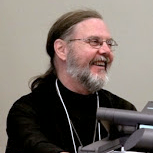
About Fr. Lawrence Farley
Fr. Lawrence currently attends St. John of Shanghai Orthodox Church in North Vancouver, BC. He is also author of the Orthodox Bible Companion Series along with a number of other publications.