
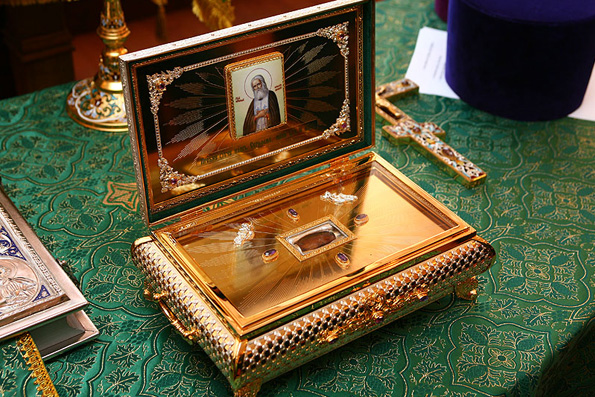
In my experience it’s a safe bet that most Protestants are not enthused about the veneration of relics— i.e. bits of a saint’s bone or bits of things they once used, such as pieces of their clothing (these are called “secondary relics”). That would apply even to Protestant “saints”: if I came to a Lutheran carrying a fragment of Martin Luther’s shinbone in a fancy reliquary box and asked him if he would like to venerate it, he would probably take a pass and reply, “Thanks anyway.” If I came to a Calvinist with a similar fragment of Calvin’s shinbone in a reliquary and made the same offer, he would probably knock the box from my hand with a stern Genevan rebuke.
Anglicans are, admittedly, a mixed bag. Some High Church types might gratefully venerate a relic of St. Edward the Confessor while others (like the late “low church” J. I. Packer) might politely demur and quote from the Church of England’s “Thirty-nine Articles” which said that “the Romish Doctrine concerning … Relics… is a fond thing, vainly invented, and grounded upon no warranty of Scripture, but rather repugnant to the Word of God.”
Anyway, Protestants in general are not enthused about the veneration of saints’ relics. They consider this a superstitious vestige (I almost said “relic”) of the superstitious medieval past, now best forgotten and left in the dustbin of history. Besides, they ask, what good could it possibly do to kiss a bit of saint’s bone?
The early church would not have agreed. In fact, the devotion to the martyrs, a reliance upon their heavenly intercession, and a veneration of their relics were firmly established by the second century. Please note: that is well before the final settling of the limits of the New Testament canon. The early church of the second century might not have known whether the Book of Revelation should be read in the assembled church as Scripture, but it did know that the relics of the martyrs were to be valued and venerated.
We find evidence for this enthusiasm for relics in the account of the Martyrdom of Polycarp who died ca. 156 A.D. Polycarp was the aged bishop of Smyrna, arrested and brought into the arena where he was to die. The government official was reluctant that such an old man should suffer such a horrible death (Polycarp was in his eighties) and strove to release him, talking to him quietly and saying, “Look: what harm is there in saying, ‘Caesar is Lord’, and in sacrificing and so make sure of your safety? Swear by Caesar, and I will set you free; revile Christ!" Polycarp when pressed at length responded, “Eighty and six years I have served Him, and He never did me any harm— how then can I blaspheme my King and my Saviour?” This sealed his fate; the bishop of Smyrna was murdered that day to the tumultuous applause and pleasure of the assembled pagan crowd.
But that was not the end of the story. The narrator goes on and we quote in full from chapter 17 of the document quoted above.
“But when the Adversary of the race of the righteous, the envious, malicious and wicked one [i.e. the Devil] perceived the impressive nature of Polycarp’s martyrdom, and how he was now crowned with the wreath of immortality, having beyond dispute received his reward, he did his utmost that not the least memorial of him should be taken away by us, although many desired to do this and become possessors of his holy flesh. For this end he suggested to Nicetes to go and entreat the governor not to give up his body to be buried, lest, he said, forsaking Him that was crucified, the Christians begin to worship this one instead. He was ignorant of this, that it is neither possible for us ever to forsake Christ, who suffered for the salvation of such as shall be saved throughout the whole world (the blameless one for sinners ) nor to worship any other. For Him indeed we adore, since He is the Sonf of God, but the martyrs, as disciples and followers of the Lord, we worthily love on account of their extraordinary affection towards their own King and Master, of whom may we also be made companions and fellow disciples!”
Please note again: by the middle of the second century it was already a firmly-established custom among Christians to gather the relics of the martyrs, and to “become possessors of their holy flesh”. And what then did the Church do with those relics? From chapter 18 of the narrative: “We afterwards took up his bones, as being more precious than the most exquisite jewels, and purer than gold, and deposited them in a fitting place, whither being gathered together, as opportunity is allowed us, with joy and rejoicing the Lord shall grant us to celebrate the anniversary of his martyrdom, both in memory of those who have already finished their course and for the exercising and preparation of those yet to walk in their steps.”
In other words, the relics were deposited in a place of honour to which the faithful gathered on the anniversary of the martyrdom to venerate the relics and to recount the martyr’s story, both to honour the martyr and to receive a blessing from his intercession as well as to steel others who might be similarly called to suffer for Christ. The relics brought the martyr’s presence near to them in power.
So, we might ask, given that this was so early an integral part of the Church’s life, what happened? Well, the medieval western church happened, with all its glorious developments and its lamentable abuses.
This last included the commodification of grace, the rustic notion that we earn our salvation (i.e. our entrance to heaven after due time spent in Purgatory) by doing things, things like attending Mass (note: not necessarily communing at Mass), and asking for saints to intercede for our salvation (the more saints the better), and buying pardons and indulgences, and venerating relics. By “commodification” I mean that grace was now something obtained, either by effort or with money, and that attending or paying for ten Masses got you ten times more grace than attending or buying one Mass.
In the case of relics, the western church of the sixteenth century did a brisk business, and some of the relics were manifestly fake. For example, Martin Luther’s protector Frederick of Saxony had amassed a collection at the Wittenberg church of 17,000 relics which included a piece of Moses’ burning bush, parts of the holy cradle and swaddling clothes, 33 fragments of the holy cross and no less than 204 assorted bits of the holy Innocents. (See A.G. Dickens’ Reformation and Society in Sixteenth-Century Europe for more.) It was a lucrative operation. Presumably the salesmen suggested that the more relics you kissed, the more grace you would receive and the less time you would spend in Purgatory.
It is important to remember that such abuses drew protests from many thoughtful men in the western church of the time, including loyal Catholics who did not join the Protestant movement. But the notion that grace was a commodity that could be obtained and stored away undergirded much (though not all) of medieval piety and it was at this which its critics (including the Protestant Reformers) took deadly aim. That is why the bit from the Thirty-nine Articles quoted above denounced not only relics but also purgatory, buying church pardons, venerating images and invoking the saints. For them it all formed part of one indivisible industry and relics were rejected along with rest of it.
This medieval industry with all its fakery (let’s call it what it was) lived and thrived in a different spiritual universe than that of the veneration of martyr’s relics as practised in the early church. For the early church, the issue was not grabbing as much grace as you could before you were packed off to Purgatory but love for the martyr whose relics were before you.
Central to the act of veneration was the relationship with the martyr himself: you knew through prayer the martyr whose relic you kissed and you relied upon his heavenly intercession— not to limit your time in Purgatory but to help you serve the Lord throughout your life, which possibly included being faithful unto a martyric death yourself. To quote from the Martyrdom of Polycarp again, one read the martyr’s story and invoked the martyr’s prayers “for the exercising and preparation of those yet to walk in their steps.”
In Orthodoxy today we venerate the relics of the saints out of the same love for saints with whom we have a personal relationship. Not “forsaking Him that was crucified” but rather loving the martyrs “on account of their extraordinary affection towards their own King and Master”. The saints are not Christ’s rivals but His friends— and therefore our friends too. Consistent with this, those who made a pilgrimage to Rome in ancient days to venerate the relics of Sts. Peter and Paul did not describe themselves as visiting the relics of Peter and Paul but as visiting Peter and Paul.
This means, for example, that the notion of laying out a collection of relics to venerate en masse (such as Frederick did with his 17,000 relics) is not really the point, for the point is not just kissing relics but loving the saint or martyr. The kiss is merely the expression of the love. The goal is not “getting grace” as if grace were a commodity to be seized upon and stored (like collecting food stamps) but rather approaching the saint and receiving the benefit of his presence and his prayers. The grace and the blessing, obtained through our contact with the relics, are rooted in the mutual love between us and the saint whose relics we kiss. Relics are not part of an industry but a relationship.
It might help our ecumenical approach to our Protestant friends if the difference between the early church and the medieval church were kept in mind and maybe even explained. In commending the veneration of relics we Orthodox are not siding with Frederick of Saxony and other medieval businessmen. We are remembering and learning from our early church past.

About Fr. Lawrence Farley
Fr. Lawrence currently attends St. John of Shanghai Orthodox Church in North Vancouver, BC. He is also author of the Orthodox Bible Companion Series along with a number of other publications.